
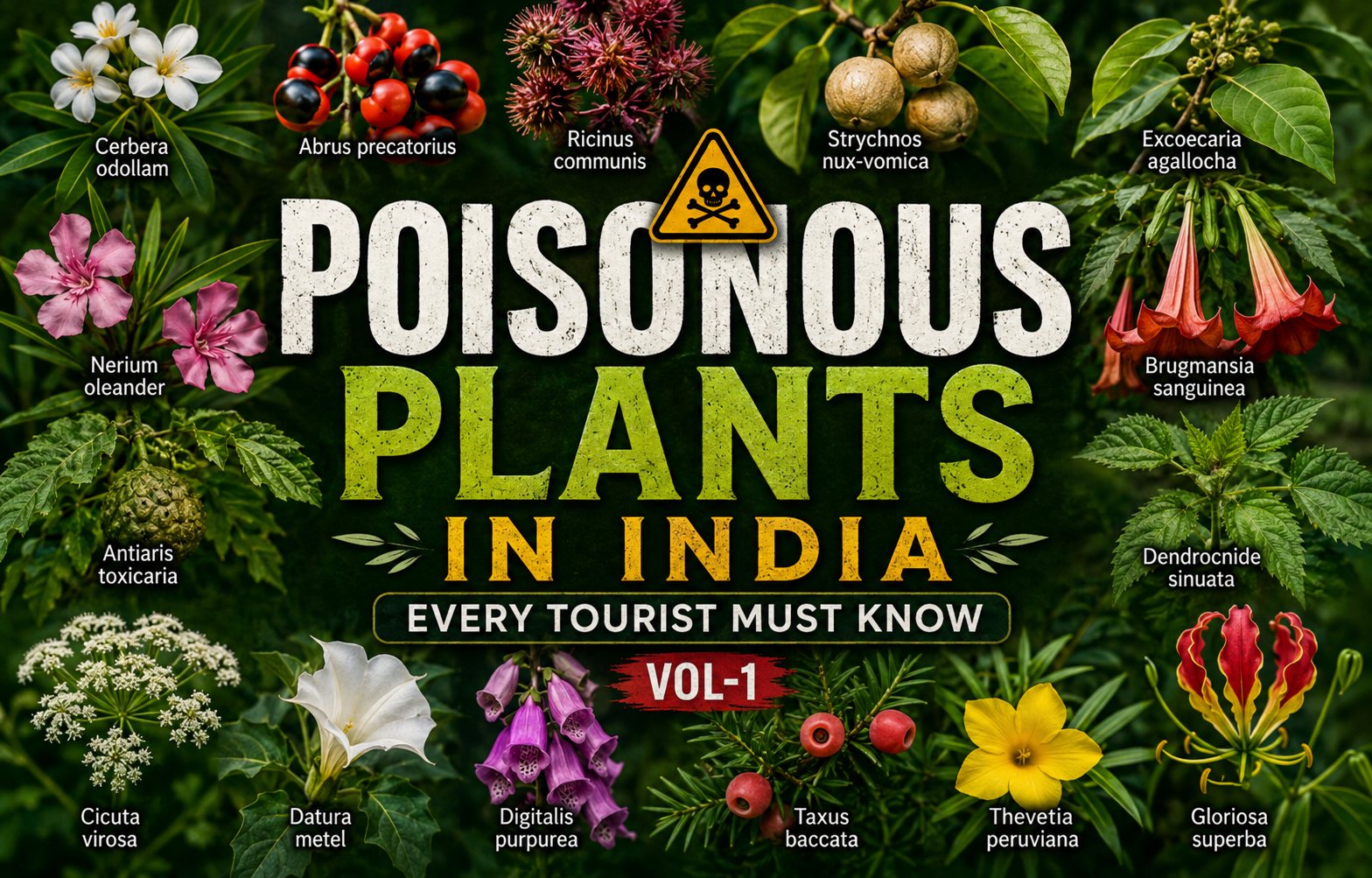

India is one of the most attractive tourist destinations. India is a blend of cultures, scenic forests, mountains, valleys, rivers, spiritual places, beaches, tropical regions, and more. However, a variety of plants are found in all of India. Some plants are dangerous, and some are used for Medicine. These plants can cause breathing problems, Skin irritation, and serious health risks, even Death. Some plants look so beautiful, which is why we touch them without knowing the result. So, we share Poisonous and dangerous plants in India. Our ambition is to make your trip awesome without any issues.
Let’s discuss: Poisonous Plants In India Every Tourist Must Know VOL-1
…………………………………………………
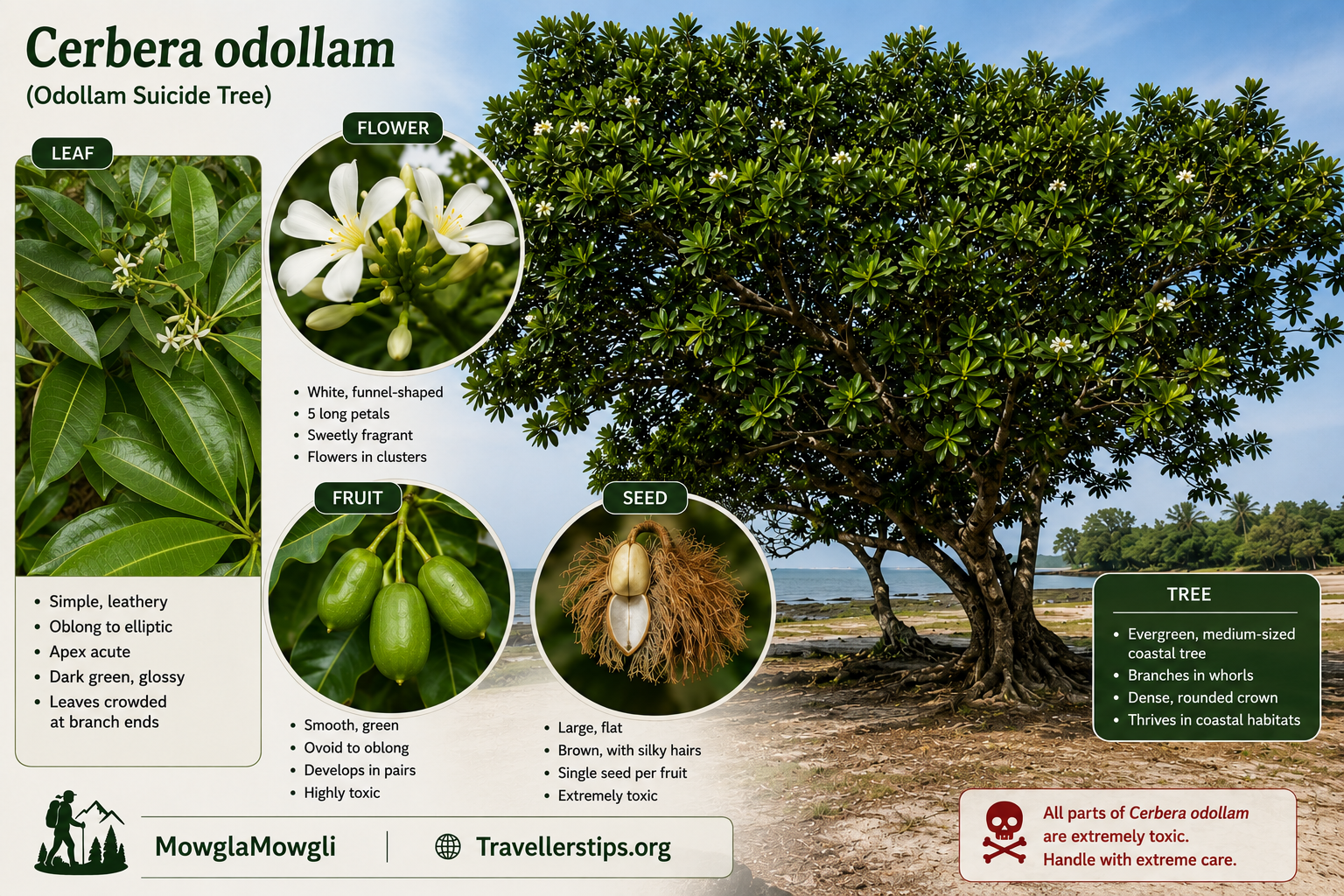
Cerbera odollam
Common Name: Suicide Tree, Sea Mango and Pong Pong tree.
—Image:1 Identification guide of Cerbera odollam—
Found:
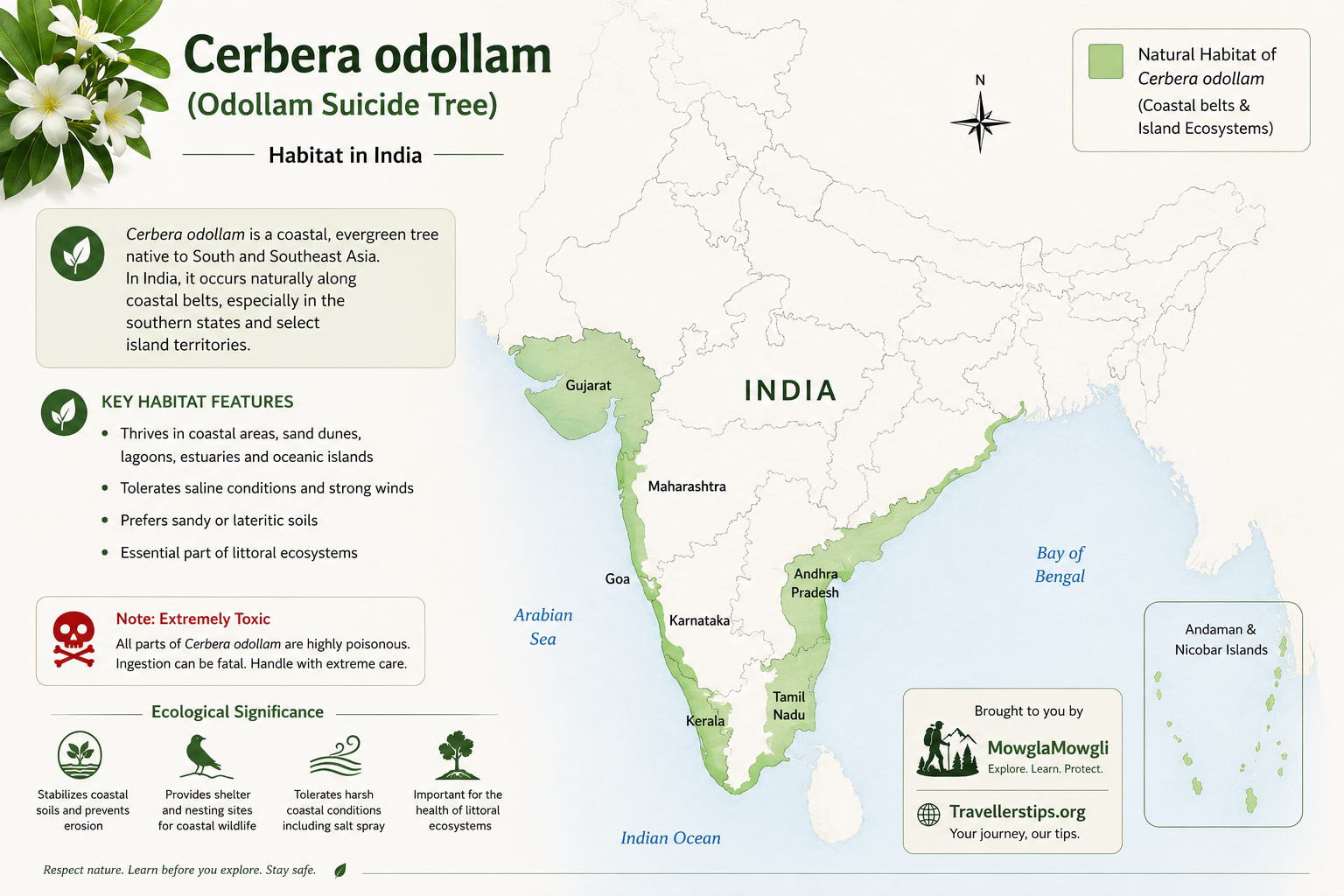
Hot and Humid climate, Mangrove vegetation, Coastal Environment and Large Backwater system are all ideal habitats of this poisonous plant. Mostly they are found in Kerala, also found in West Bengal (Sundarban), Odisha, Karnataka, and Tamil Nadu,
Important facts :
- Cerbera odollam is one of the most poisonous and deadliest plants in Asia.
- The seed contains the most powerful poison, Cerberin. It is one of the plant’s dangerous parts.
- This Poison directly attacks the heart.
- Any small portion of a seed can kill a Human.
—Map:1 Habitat & Distribution of Cerbera odollam in India—
…………………………………………………
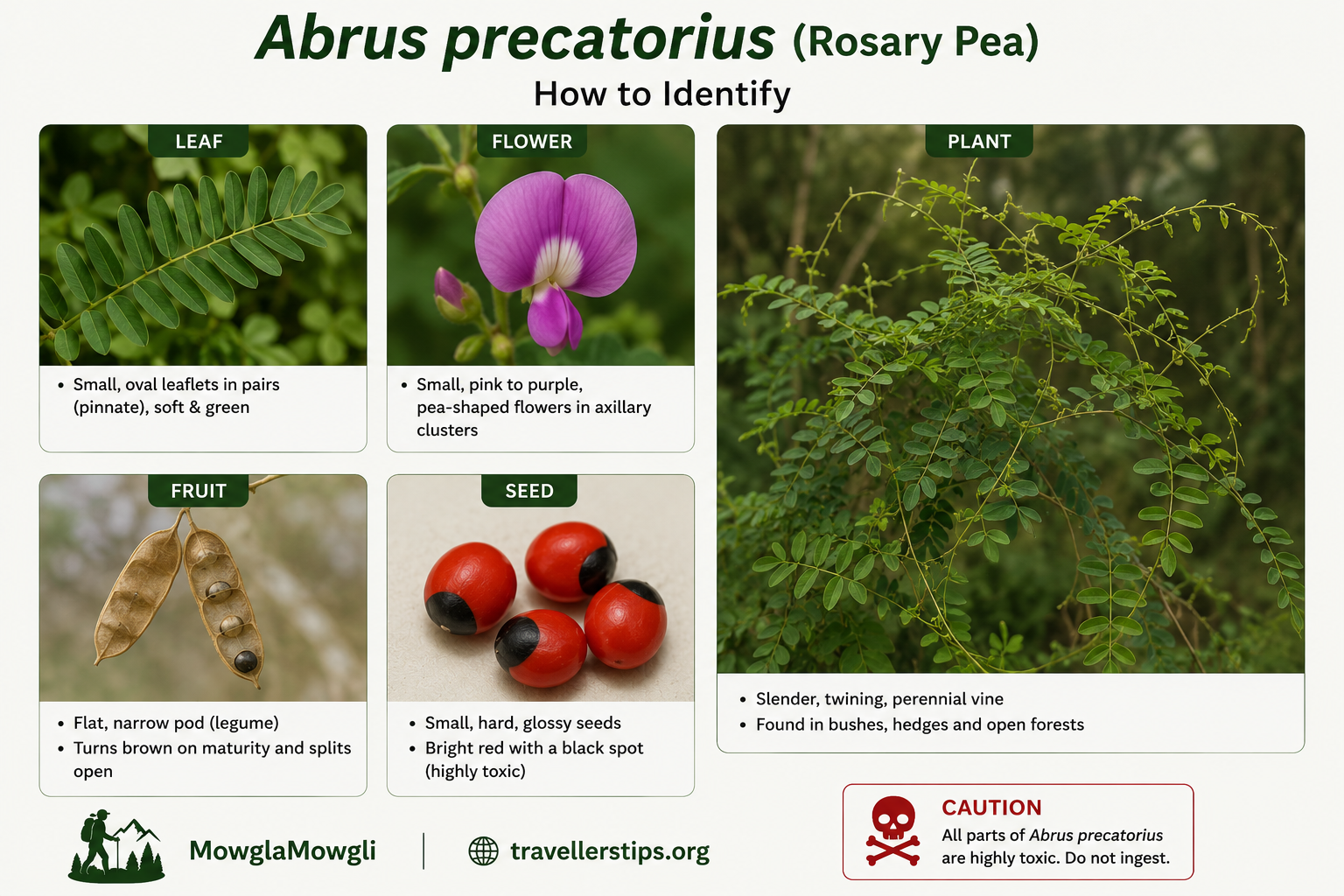
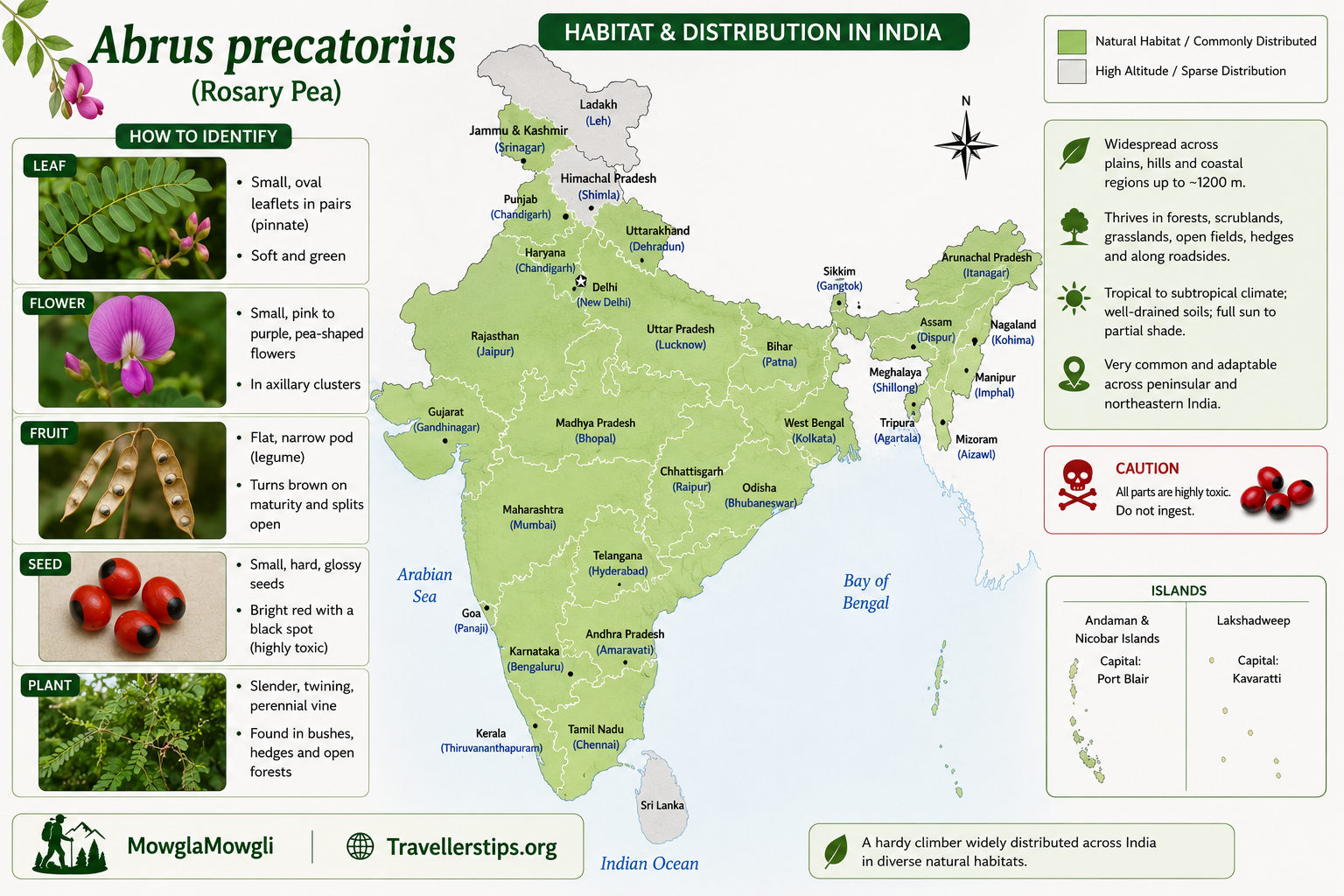
Abrus precatorius
Common Name: Rosary Pea.
—Image:2 Identification guide of Abrus precatorius—
Found: A warm tropical climate is the ideal habitat for this plant. Generally, it is found in the roadside, Forest edge and Coastal area. They are mainly found in Kerala, Tamil Nadu, West Bengal, Maharashtra, Karnataka and Odisha.
Important Facts:
- Abrus precatorius contains the deadly protein toxin Abrin. It suppresses the production of protein.
- The seed is more dangerous than other portions of the plant.
- Ancient Indians used the seeds for a weight unit, which they named “Ratti“.
- Attractive but very dangerous, especially since it is dangerous for children.
—Map:2 Habitat & Distribution of Abrus precatorius in India—
…………………………………………………….
Ricinus communis
Common Name: Castor Bean Plant
—Image:3 Identification guide of Ricinus communis—
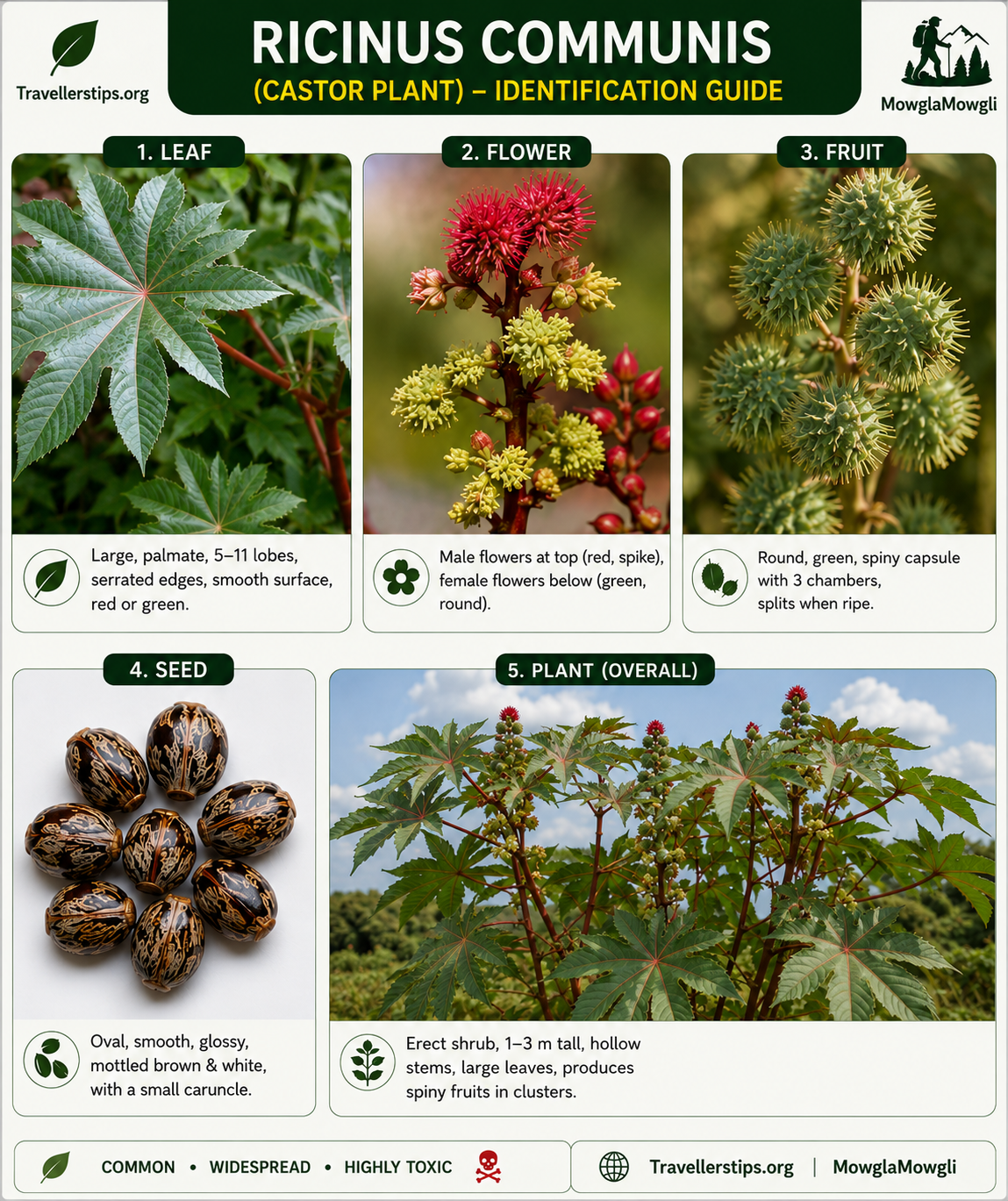
Found :
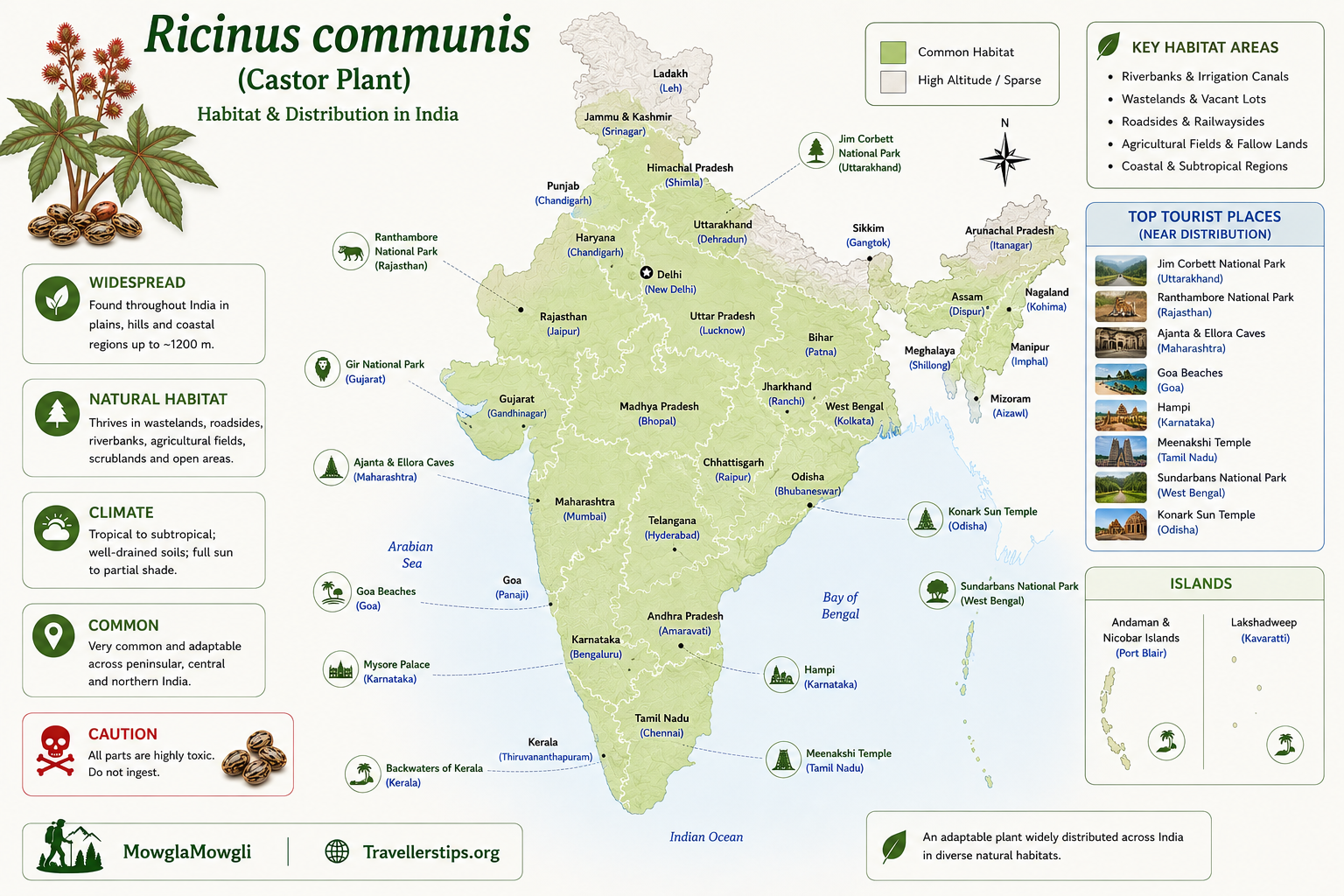
- Area: They are growing in warm temperatures. We observe it near the Roadside, riverbank, Cultivation field and also empty land.
- Location: Basically, it is found across tropical India. They are mostly found in Gujarat, Rajasthan, Telangana, Andhra Pradesh, West Bengal, Tamil Nadu, and Odisha.
Important facts :
- Ricinus communis contains the highly toxic protein Ricin. Ricin prevent the production of protein and damages the cell.
- Seeds are an extremely dangerous part compared to other parts of the plant.
- It is also used for medicine, hair oil, cosmetics, and other purposes.
- Some people grow this plant in the Garden or at home for decoration because it has large and beautiful leaves.
—Map:3 Habitat & Distribution of Ricinus communis in India—
……………………………………………………….
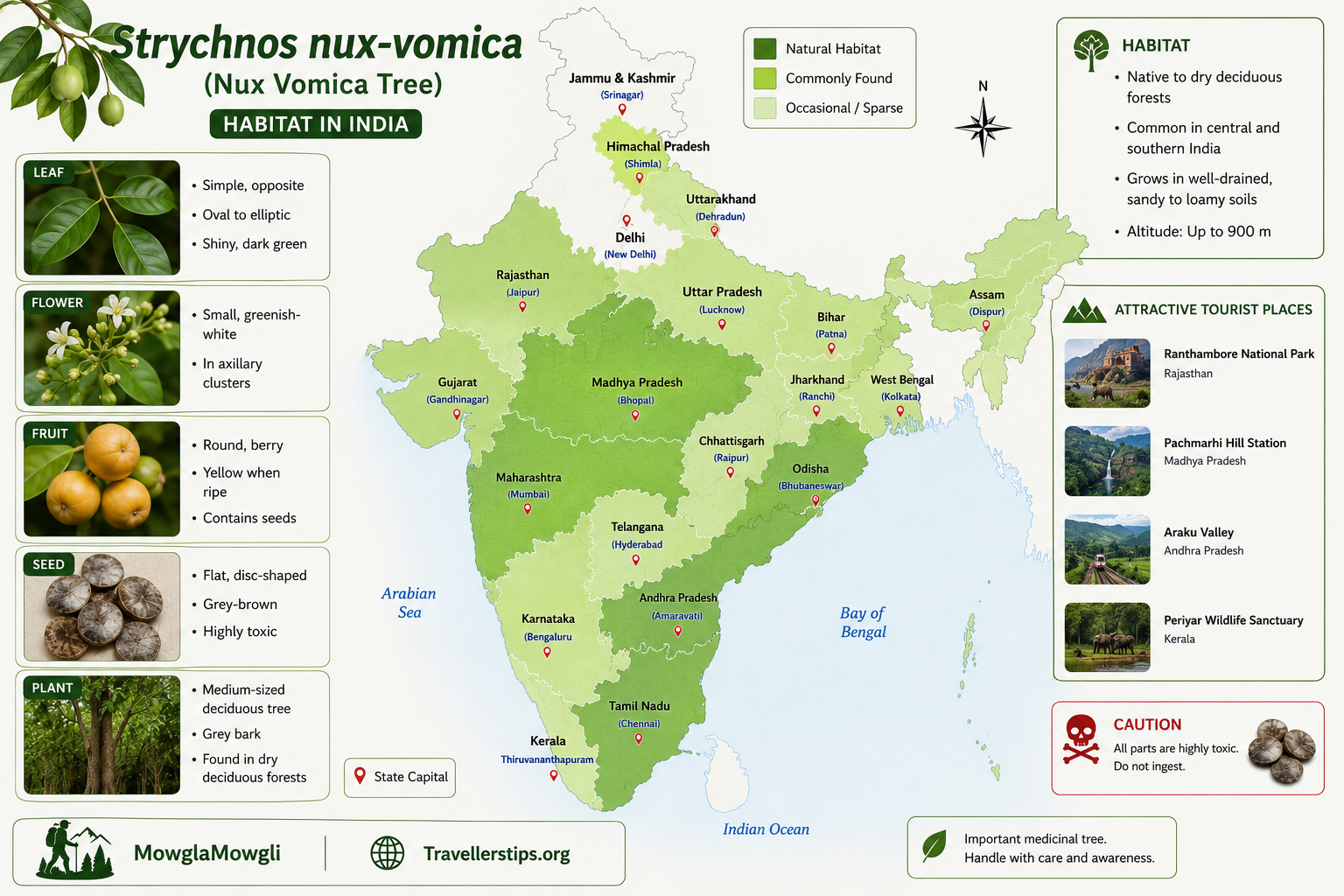
Strychnos nux-vomica
Common Name: Poison Nut Tree, Kuchila (Hindi Name).
—Image:4 Identification guide of Strychnos nux-vomica—
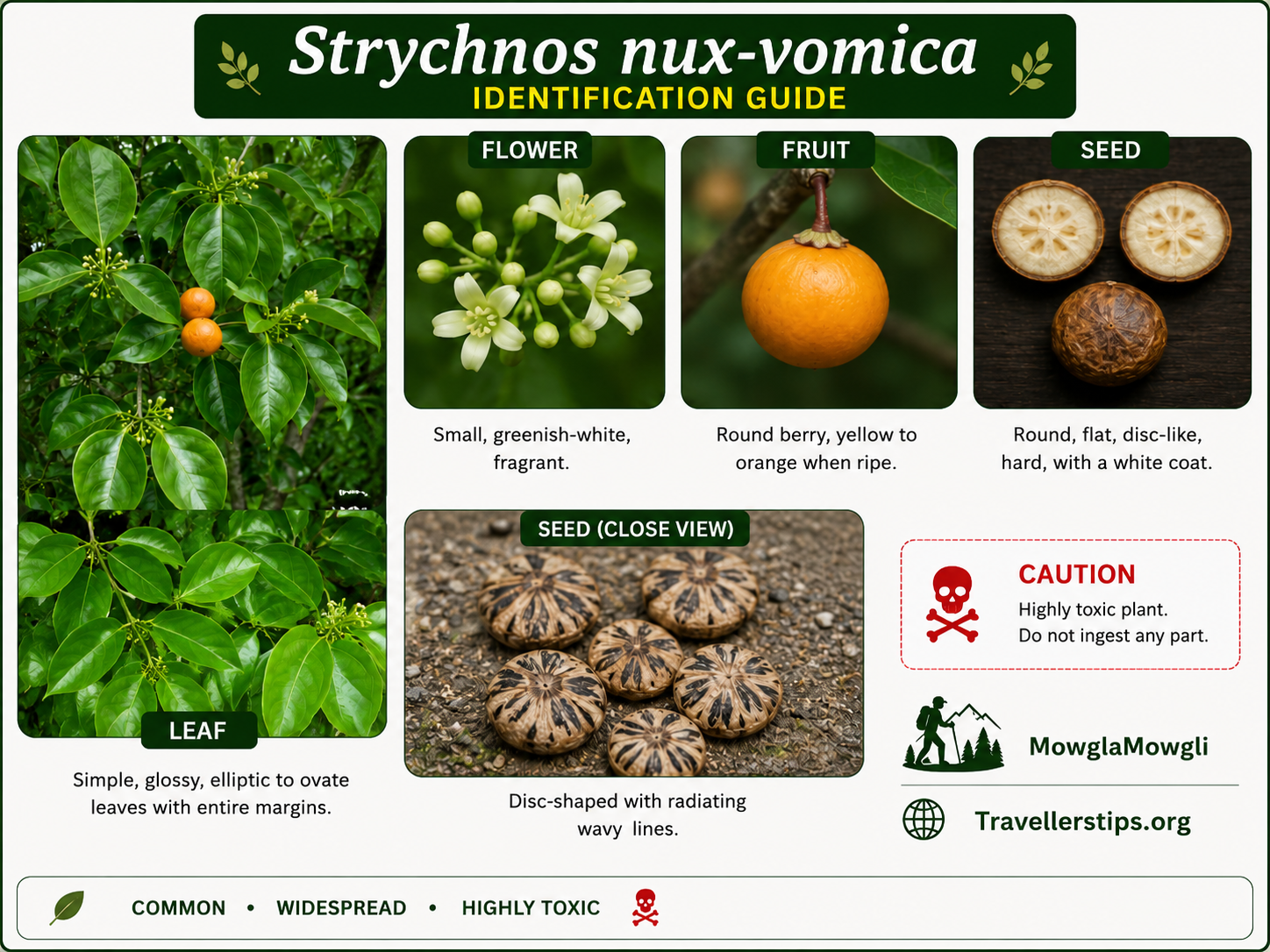
Found :
- Area: Their favourable climate is tropical and subtropical. Commonly, they grow in dry deciduous forest, forest edge, well-drained soil, Rocky areas and open woodlands.
- Location (Different states of India): They are mostly found in Tamil Nadu, Karnataka, Kerala, Assam, West Bengal, and Andhra Pradesh.
- They are also commonly found in Thailand, Sri Lanka and Myanmar.
Important facts :
- The seed is only one of the dangerous portions of this plant. It contains the most dangerous poison, brucine and Strychnine.
- Birds eat the fruit of this tree without any harmful effect, while the remaining seeds are harmful to humans and other animals.
- Fruit pulp is less harmful than the seeds.
- The wood is very strong, fine-grained, resistance from several insects and durable.
—Map:4 Habitat & Distribution of Strychnos-nux-vomica in India—
…………………………………………………..
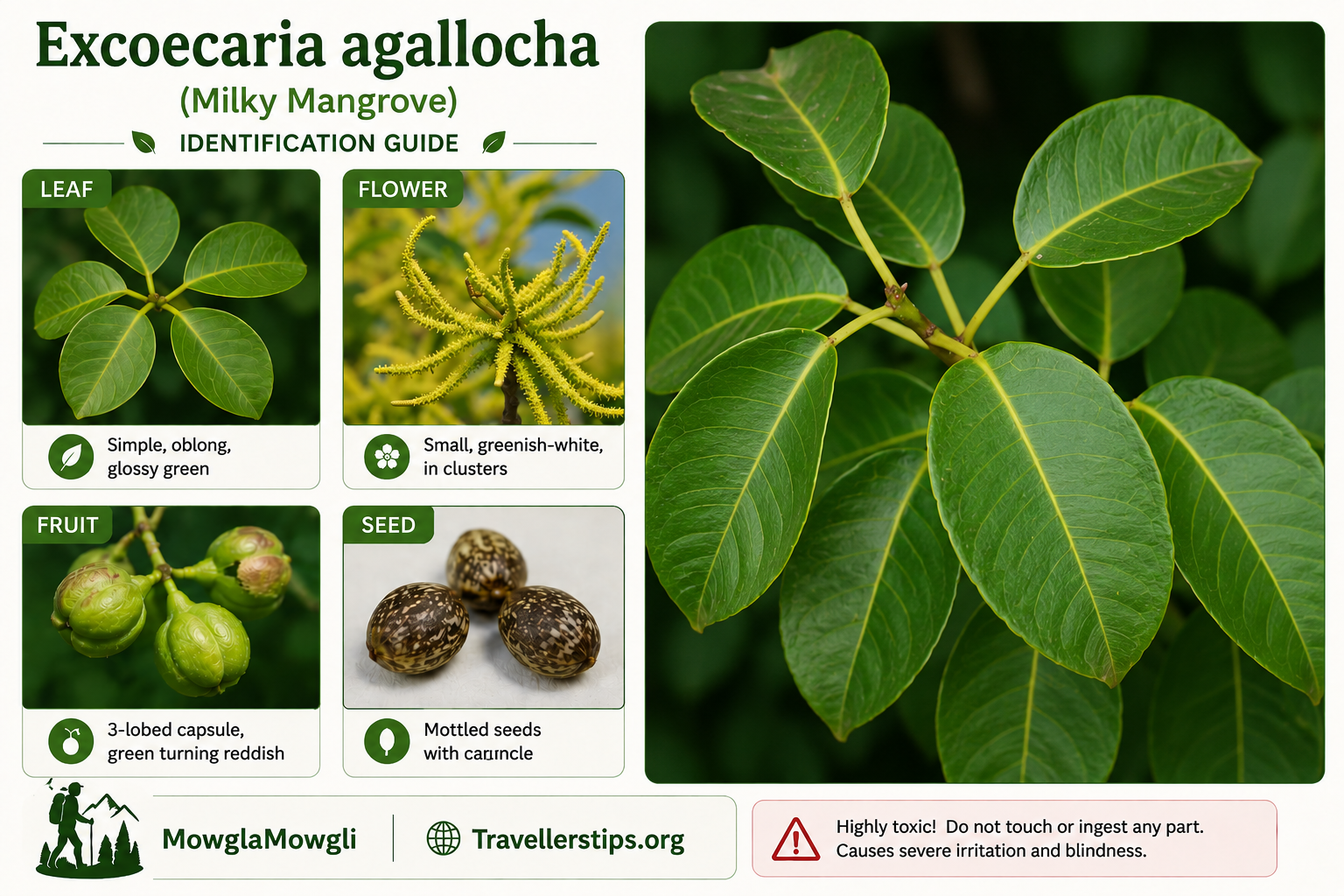
Excoecaria agallocha
Common Name: Blind your eye, Mangrove and Milky Mangrove.
—Image:5 Identification guide of Excoecaria agallocha—
Found :
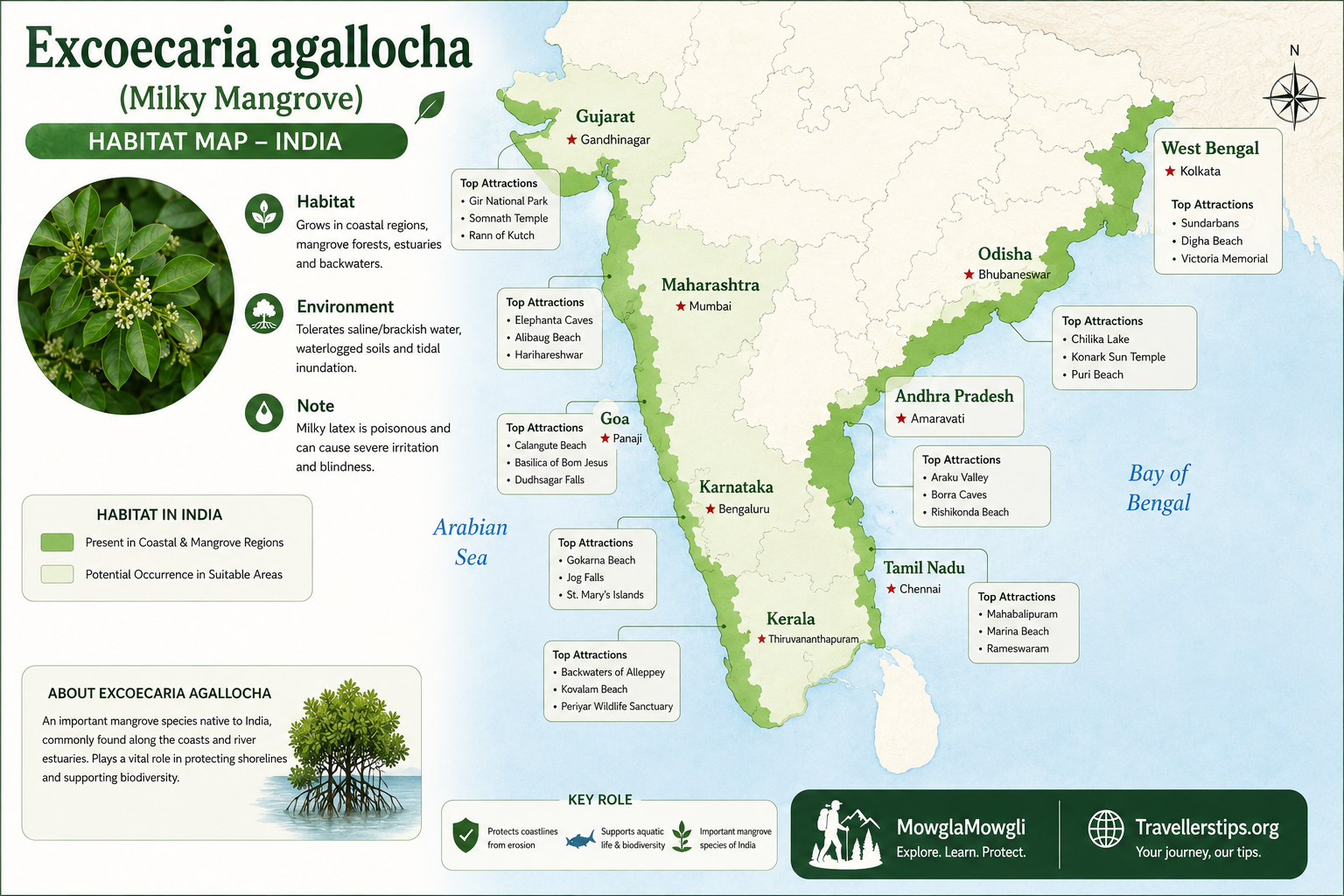
- Area: It mainly grows in the coastlines of the Tropical and Subtropical regions. They also grow in coastal wetlands, mangrove forests, Tidal creeks, and estuaries.
- Location: They are found throughout India in different locations. Some common habitats of this plant are Tamil Nadu, Goa, Kerala, Gujarat, West Bengal (Sundarban), Odisha (Bhitarkanika National Park), and the Andaman and Nicobar Islands.
Important facts :
- Excoecaria agallocha is one of the most dangerous mangrove trees.
- Toxicity: This plant contains highly toxic and irritating Milky latex, which is called Excoecaria toxins.
- Contact with the eyes can create temporary blindness.
- This plant is helping to protect the mangrove ecosystem and stabilise coastlines.
- The Smoke of this tree is able to irritate the respiratory tract and eyes.
—Map:5 Habitat & Distribution of Excoecaria agallocha in India—
………………………………………………..
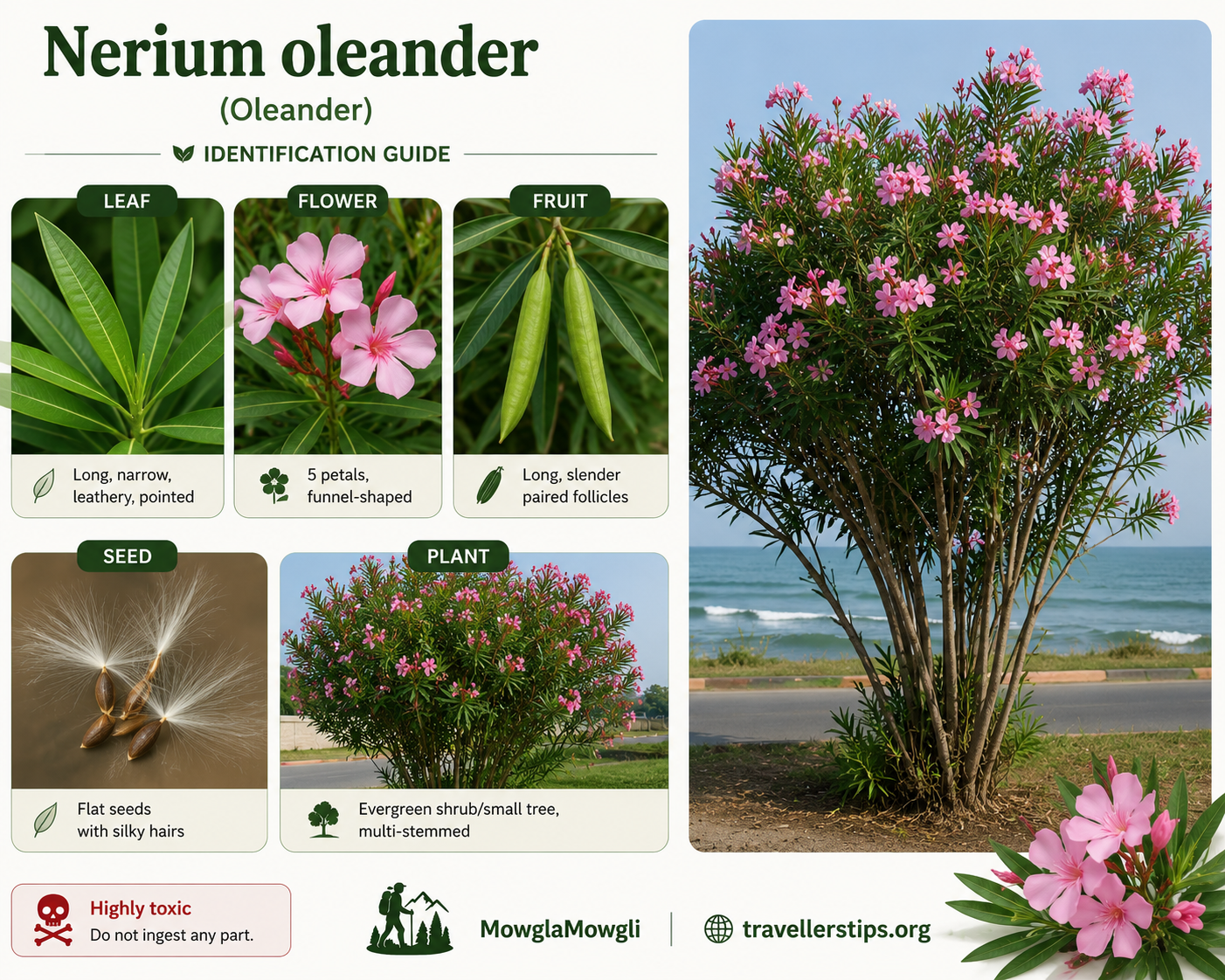
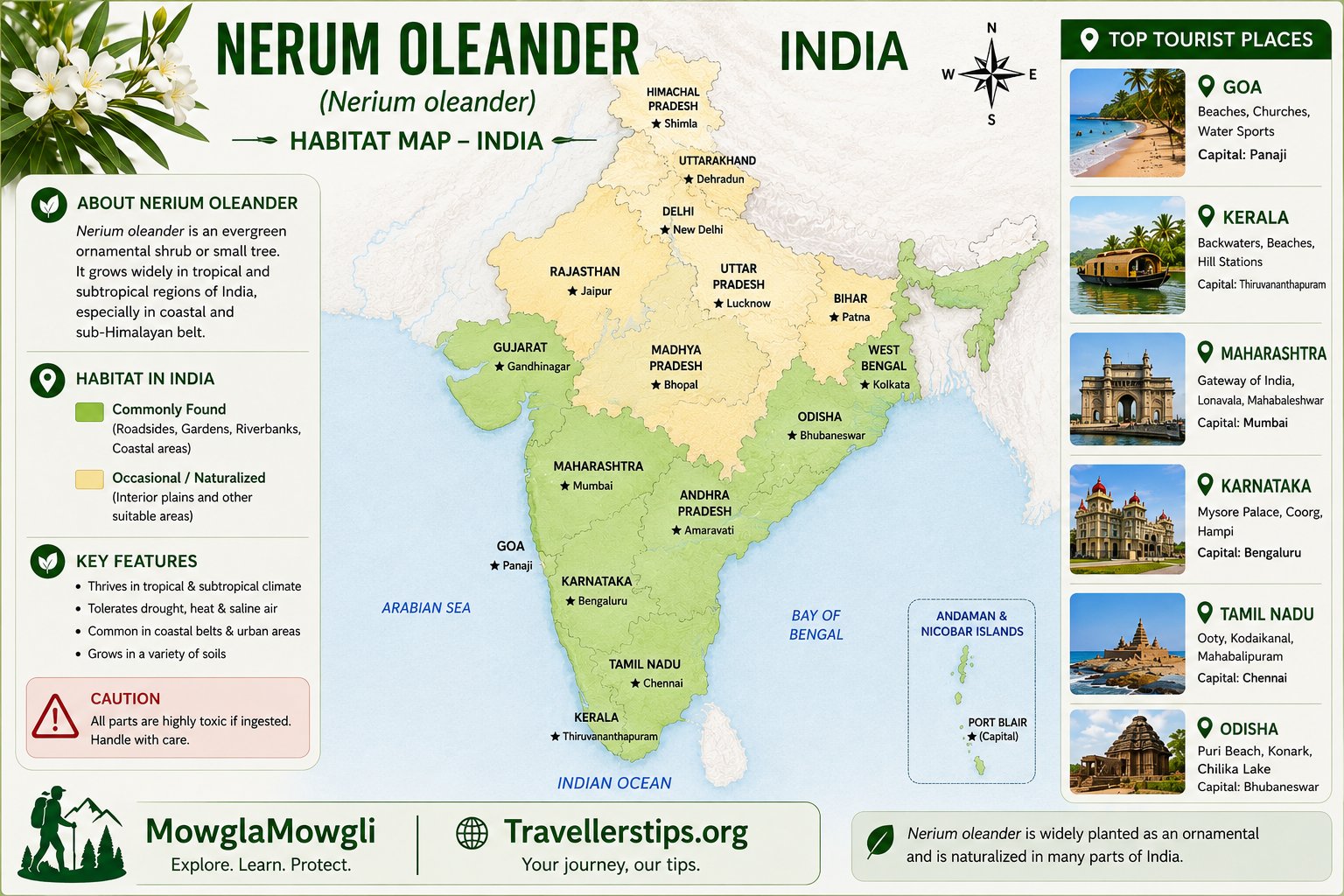
Nerium oleander
Common Name: Oleander
—Image:6 Identification guide of Nerium oleander—
Found:
- Area: Oleander is cultivated across India for its beautiful flowering shrubs. Indian people cultivate this beautiful flowering plant in gardens, on highways, in schools, in temples, in residential areas and in parks. Their favourable climate is a tropical, semi-arid and sub-tropical region.
- Location: It is found all around India.
Important facts :
- Oleander is one of the most beautiful and poisonous flowering plants.
- The toxicity name of this flowering plant is cardiac glycoside. Primarily, this poison attacks our heart and Nervous system.
- Cardiac glycosides are present in all parts of this beautiful flowering plant.
- A small amount of poison is able to create an irregular heartbeat and Death.
- A regular case found in South India related to Oleander.
—Map:6 Habitat & Distribution of Nerium oleander in India—
……………………………………………..
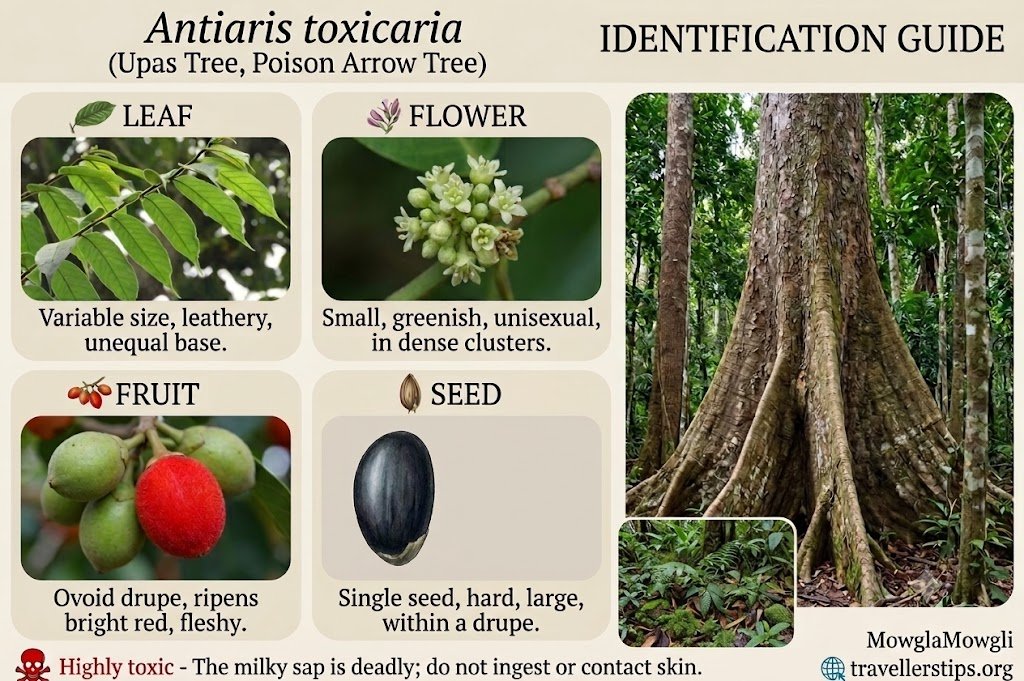
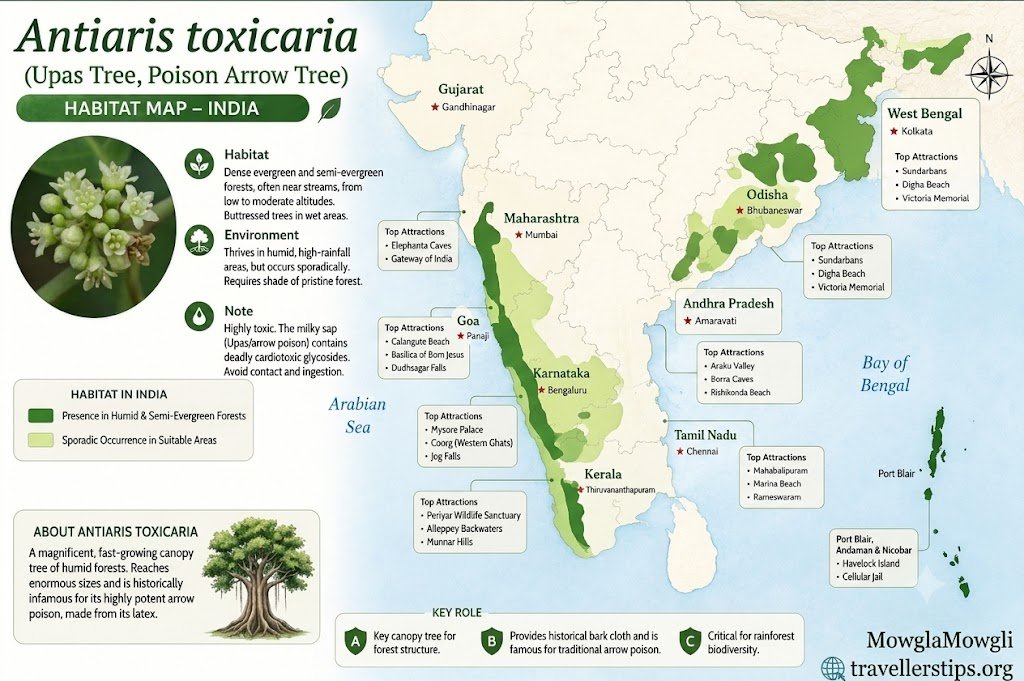
Antiaris toxicaria
Common Name: Upas Tree, Bark cloth tree and Poison arrow tree.
—Image:7 Identification guide of Antiaris toxicaria—
Found :
- Area: They primarily grow in the tropical evergreen forest, Moist deciduous forest, semi-evergreen forest, river valley and forest edges.
- Location: They are mostly found in several states in India, which are Tamil Nadu, Kerala, Karnataka, some forest regions of Andhra Pradesh, the Western Ghats, Assam and some North East regions.
Important facts :
- Antiaris toxicaria is one of the most famous toxic or poisonous trees in India and even in Asia.
- The Poison of the plant known as Antiarin. It is also known as Cardiac glycoside poison, which attacks the heart. muscle.
- Several indigenous communities use the poison (milky latex) on the arrow’s tip for hunting animals that’s why it is known as the Poison arrow tree.
- It is one of the largest forest trees; the height of the tree is 200 feet (60 Meters).
—Map:7 Habitat & Distribution of Antiaris toxicaria in India—
……………………………………………….
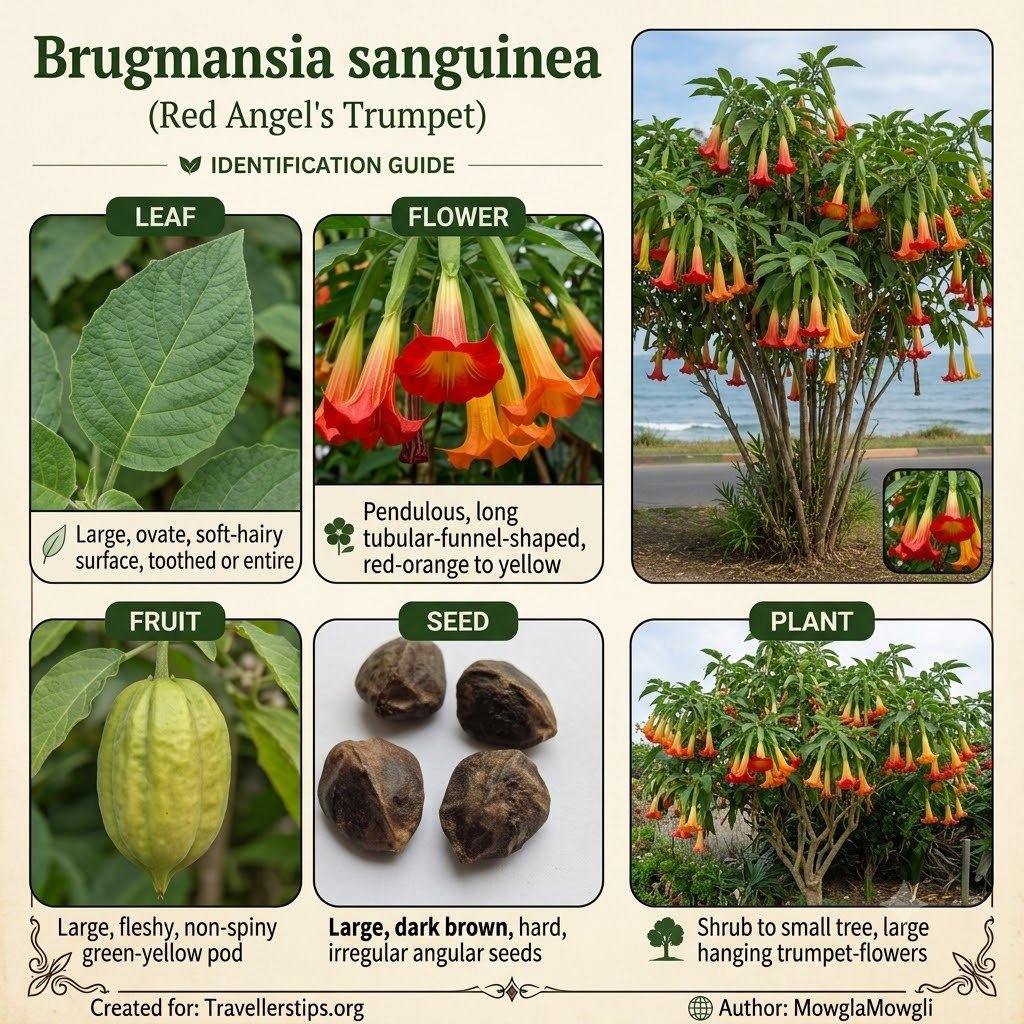
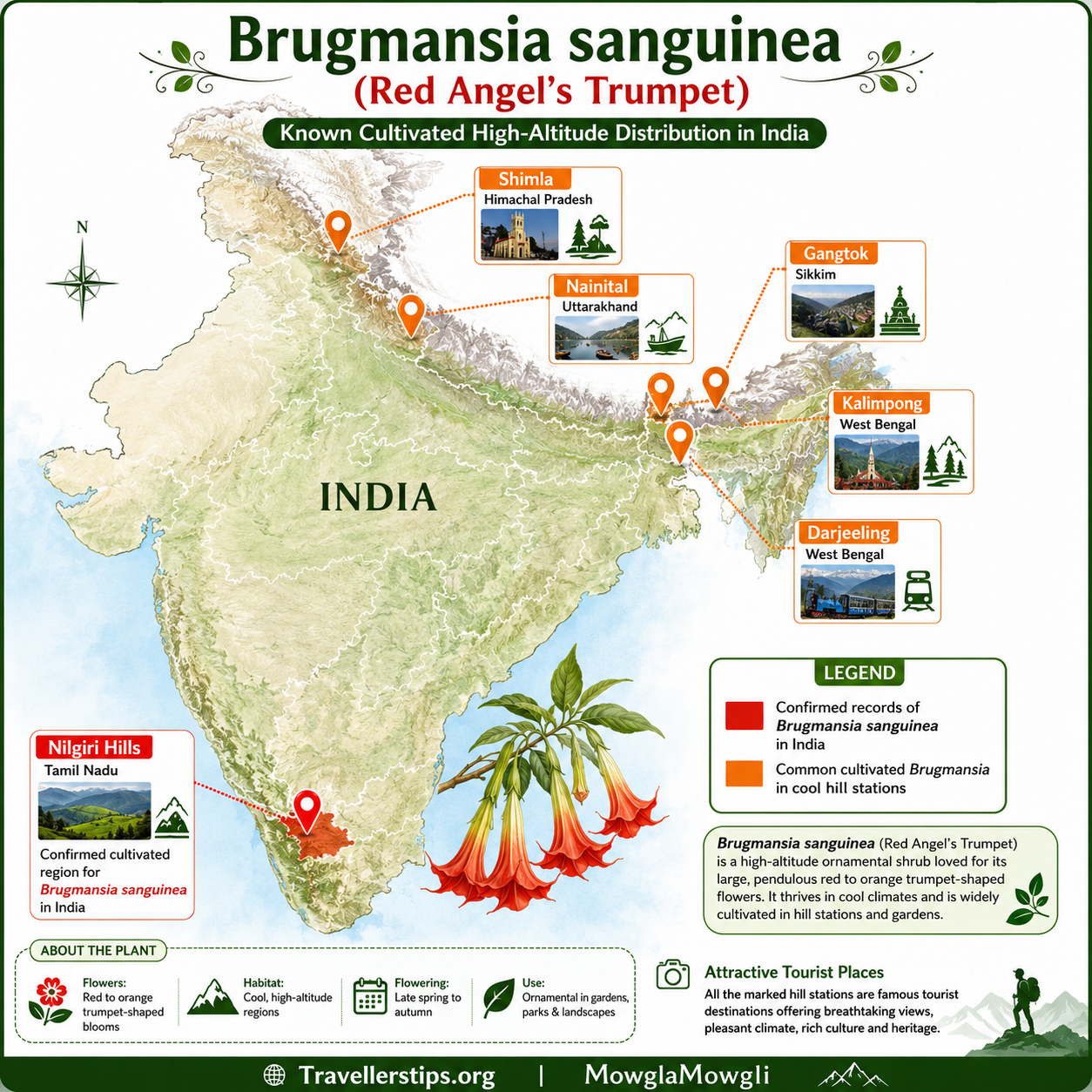
Brugmansia sanguinea
Common Name: Red Angel’s Trumpet or Scarlet Angel’s Trumpet.
—Image:8 Identification guide of Brugmansia sanguinea—
Found :
The plant’s native habitat is South America. It is also found at high altitudes in India.
- Area: Brugmansia sanguinea mainly grows in high-altitude places in India. The favourable habitat of the plant is the cool tropical and subtropical highland. It is also found in the Montane cloud forests and mountain slopes. Indian people also grow flowers in their garden and on the upper side of the gate for beautiful flowers.
- Location: It is found in different mountain range locations like Darjeeling hill (West Bengal), Sikkim, Uttarakhand, Himachal Pradesh, and Arunachal Pradesh.
Important facts :
- Red Angel’s Trumpet is one of the most beautiful and poisonous flowering shrubs.
- All portions or parts of this beautiful flowering plant are poisonous. The poison of the plant consists of Atropin, Scopolamine and Hyoscyamine. They target the nervous system.
- This beautiful flowering plant is connected with the hummingbirds for pollination.
—Map:8 Habitat & Distribution of Brugmansia sanguinea in India—
………………………………………………..
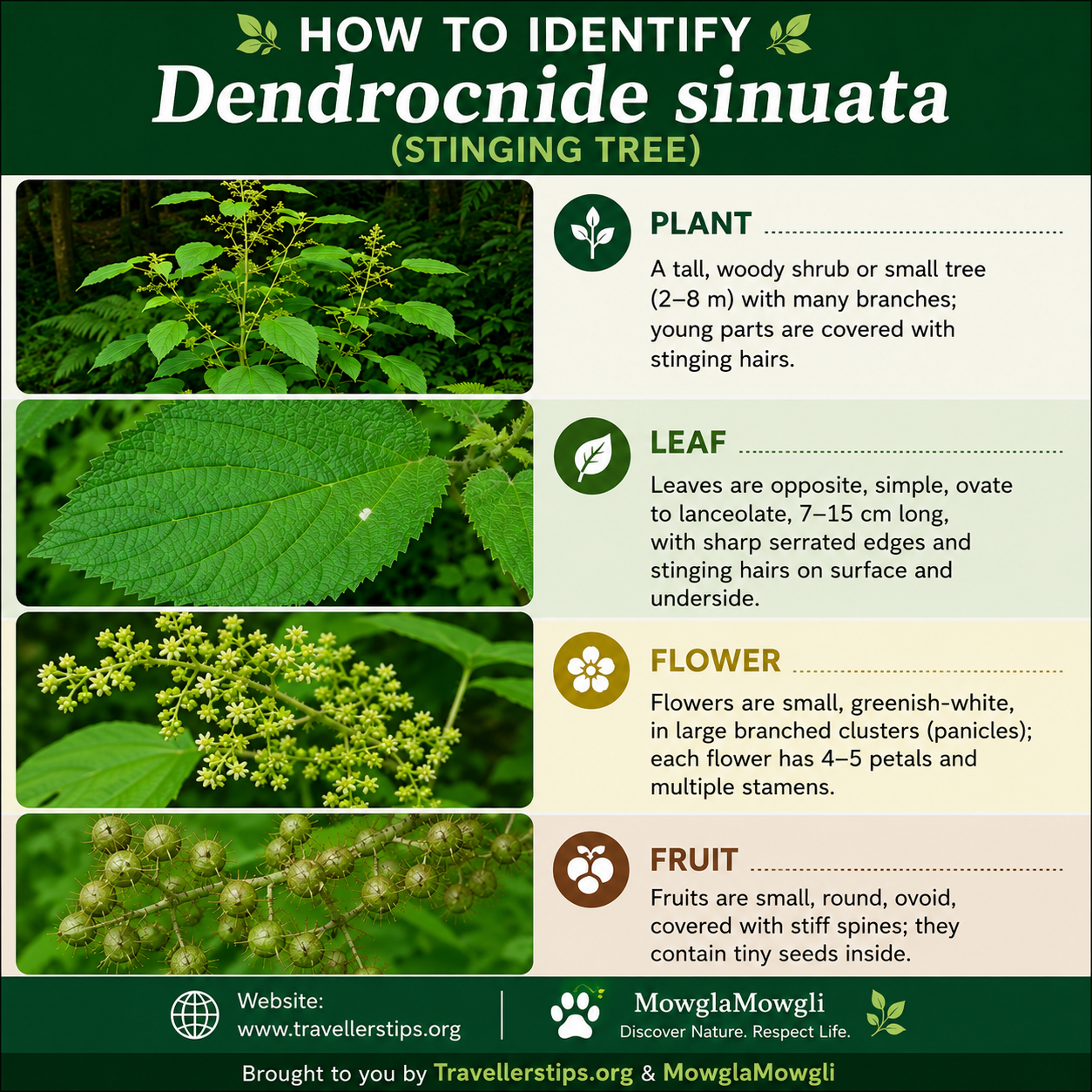
Dendrocnide sinuata
Common Name: Giant Stinging Tree, Devil Nettle and Elephant Nettle.
—Image:9 Identification guide of Dendrocnide sinuata—
Found :
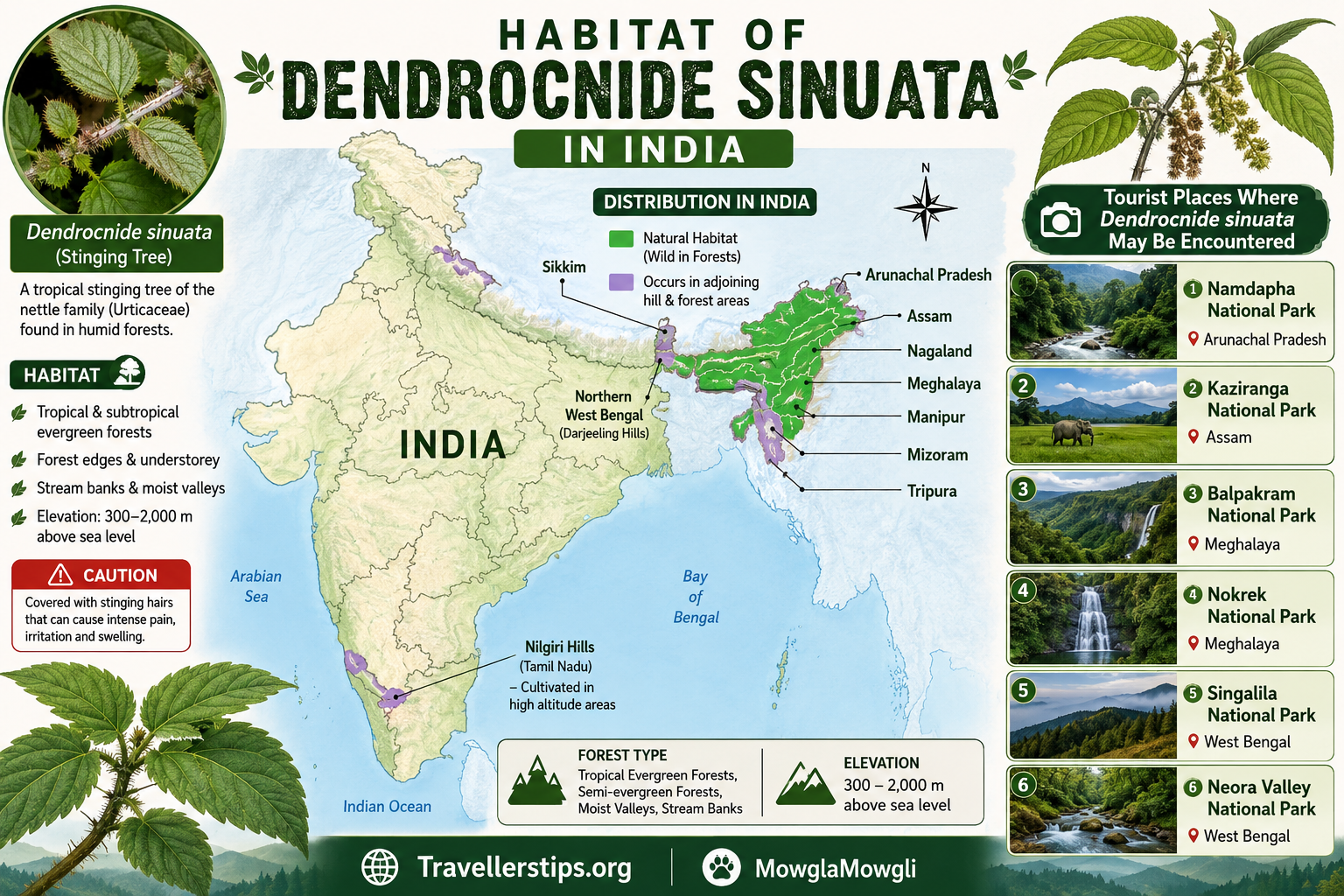
- The Native habitat of the species is South and Southeast Asia. The Favourable region of this plant is the Tropical and Subtropical rainforest. They grow in the moist evergreen and Mountain foothills forest.
- Location (India): They are primarily found in heavy-rain, humid hill forests. Manipur, Nagaland, Mizoram, Meghalaya and Tripura are the common locations of this species.
Important facts
- It is one of the highly dangerous species for humans.
- It has a microscopic needle-like projection which is highly venomous. They contain several types of venomous chemicals, which are Formic acid, Oxalic acid, tartaric acid, serotonin, and Histamine.
- The contact body parts are able to suffer from itching, burning, redness, swelling and numbness.
- According to reports, this plant rarely creates a life threat but can cause discomfort.
- This species can be found on the hiking route.
—Map:9 Habitat & Distribution of Dendrocnide sinuata in India—
……………………………………………
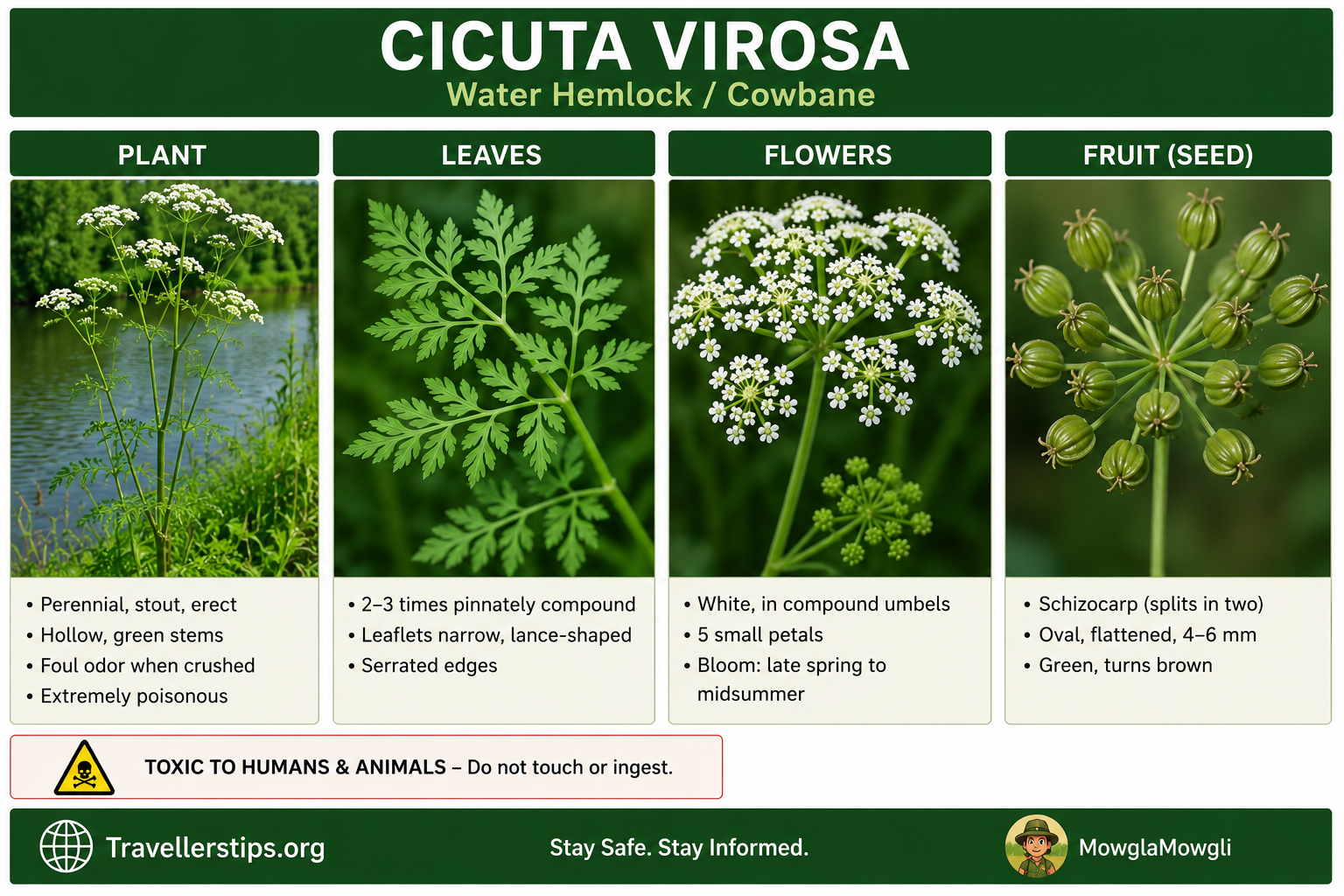
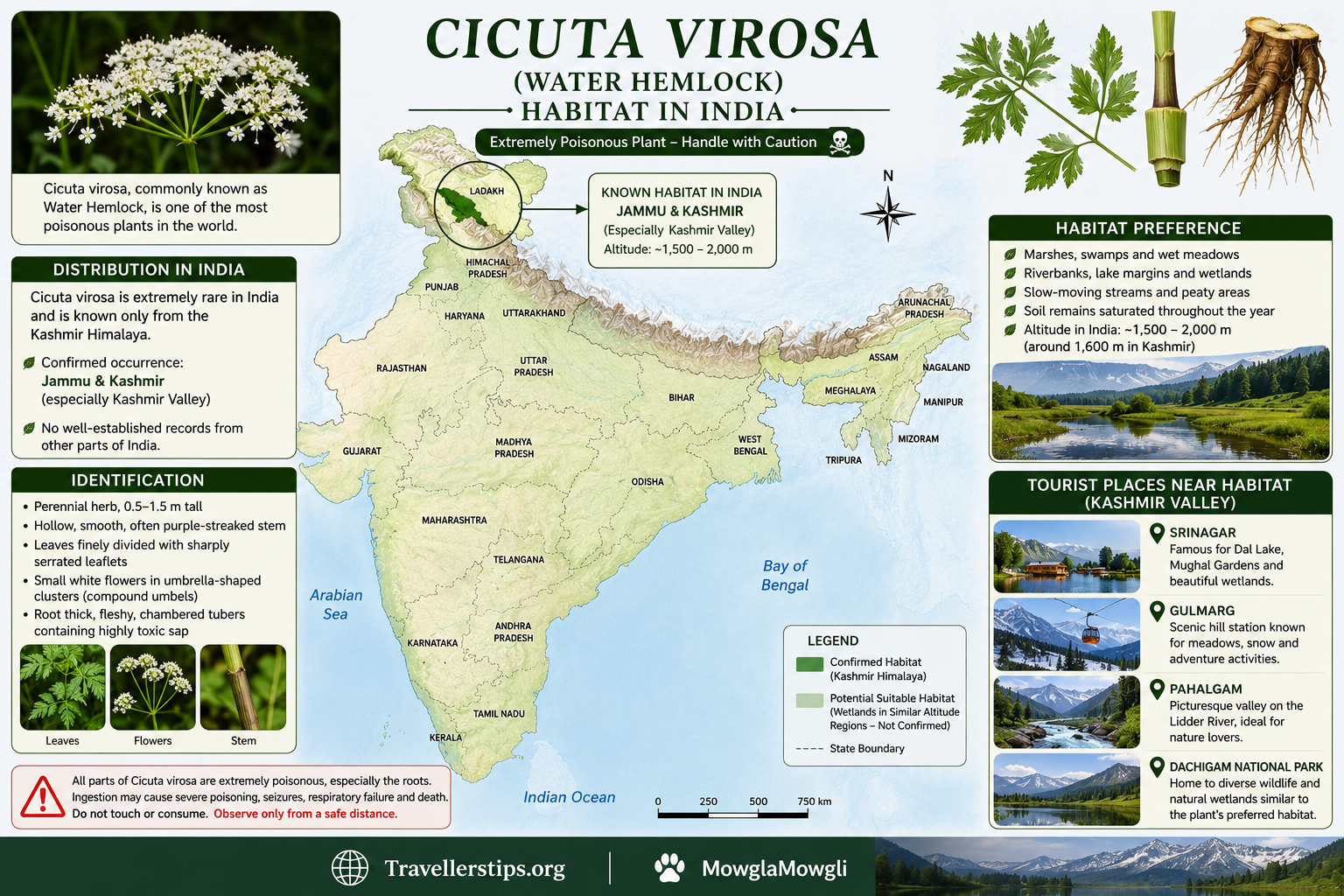
Cicuta virosa
Common Name: Water Hemlock, Cowbane and Northern Water Hemlock
—Image:10 Identification guide of Cicuta virosa—
Found :
- Area: Primarily, they grow from an altitude of more than 33 m to an altitude of 3300 m. They grow in waterlogged grasslands, Marshes, swamps, Wet meadows, river and Stream banks. They are cold-temperature plants; the ideal temperature for them is 10 to 25 degrees Celsius.
- Location (India): They are found in very small numbers in India. They are mainly found in the Western Himalaya, Moist valleys and Himalayan wetlands.
Important facts :
- Cicuta virosa is one of the most powerful poisonous plants in the world.
- All parts of the plant contain the most dangerous toxin, cicutoxin. It primarily attacks our nervous system.
- Cicutoxin is able to stop the respiratory system in our body.
- Roots are a more dangerous part than other parts of the plant.
- Cicuta virosa is able to survive under Snow cover.
—Map:10 Habitat & Distribution of Cicuta virosa in India—
…………………………………………………..
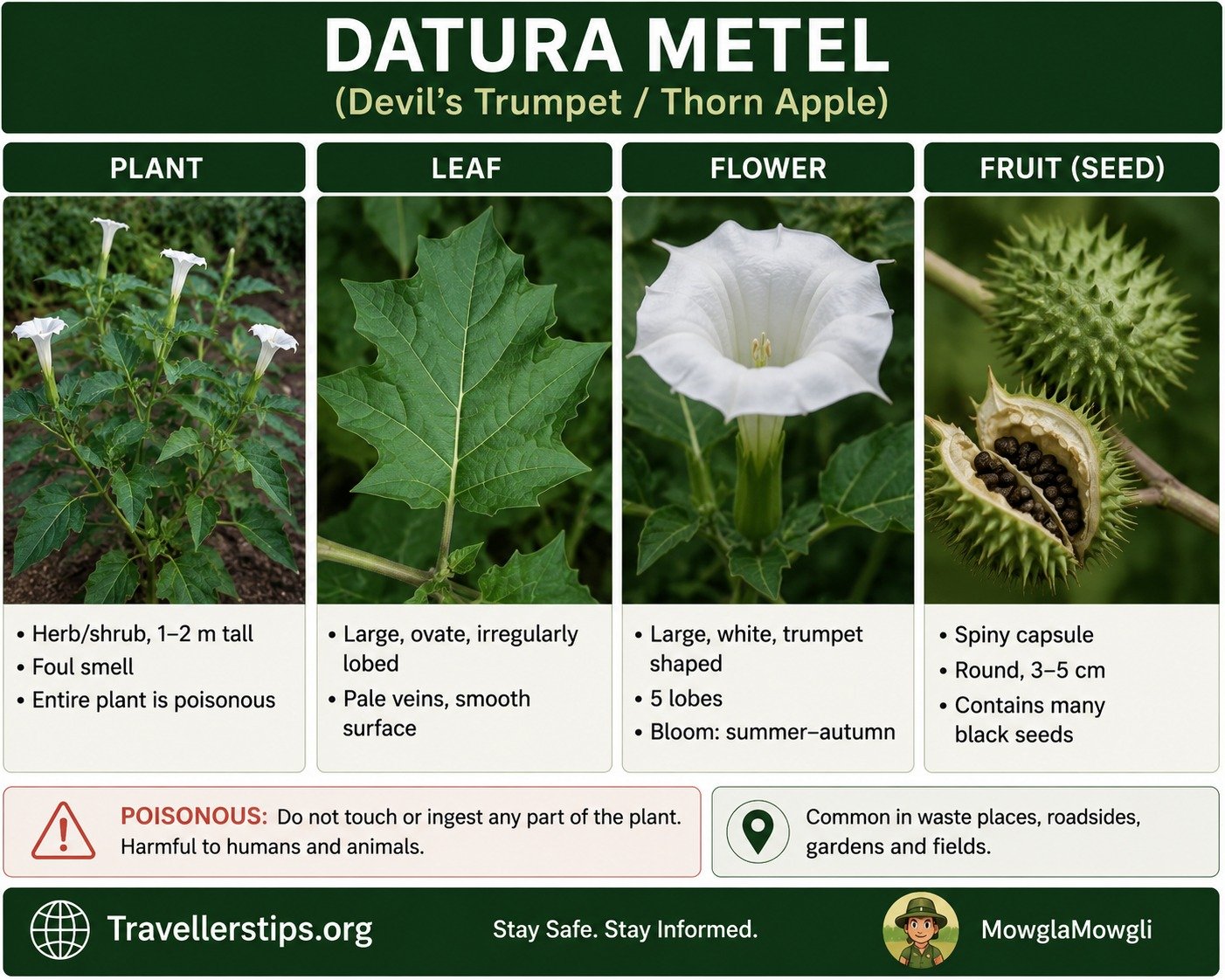
Datura metel
Common Name: Dhatura (Hindi), Jimsonweed, Devil’s Trumpet and Thorn apple.
—Image:11 Identification guide of Datura metel––
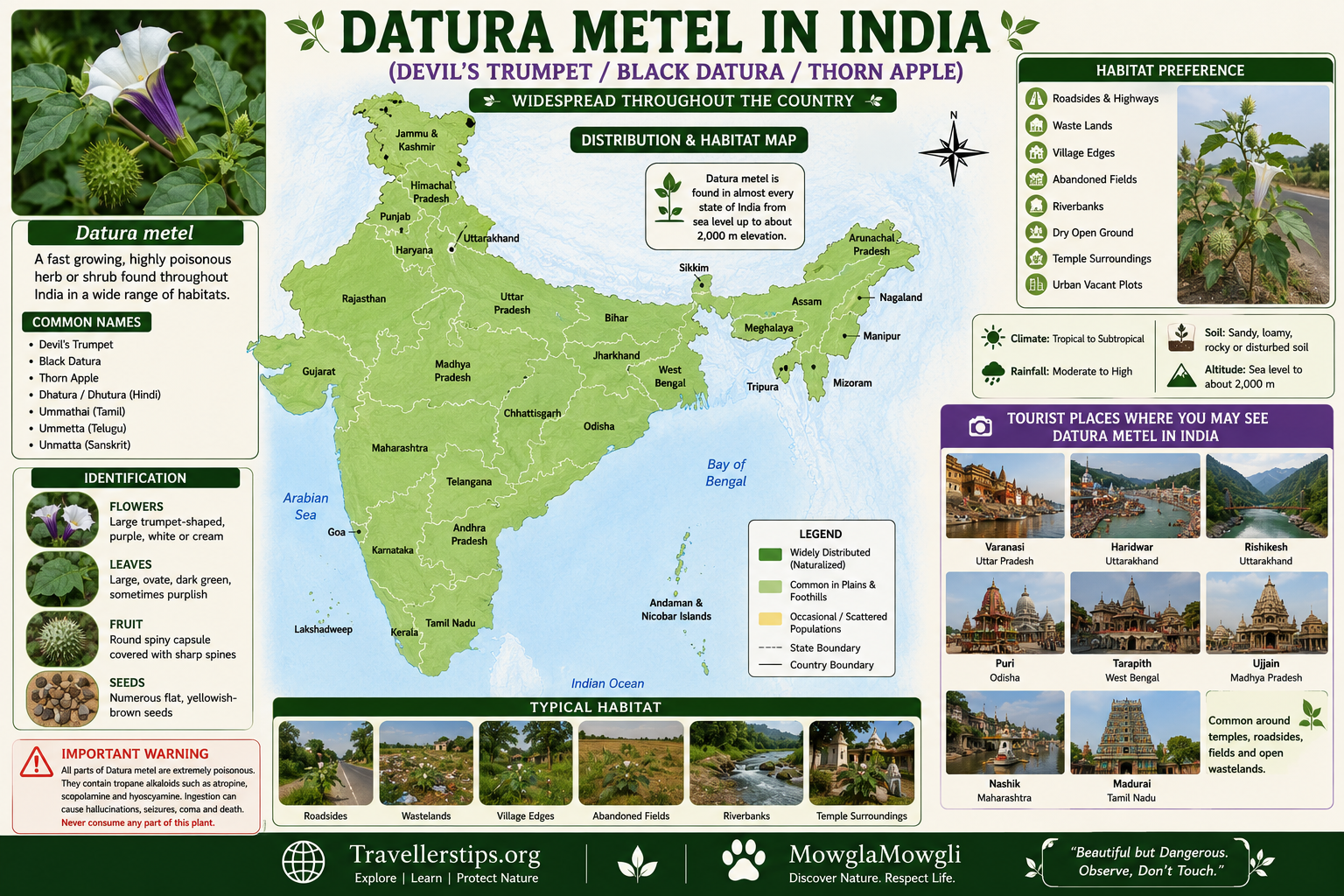
Found :
- Area: They have an ideal habitat in the tropical and subtropical regions of India. They grow in open grassland, roadside, margins of agriculture feild, wetlands, abandoned land, surrounded by a temple and also a garden.
Important facts
- Datura Metel is one of the most dangerous and poisonous plants in India.
- All parts of the plant contain Scopolamine, Hyoscyamine and Atropine.
- Seeds and flowers are more dangerous than other parts.
- If you eat seeds and flowers, then it can cause a rapid heartbeat, hallucination, coma and even death.
- Worshippers of Lord Shiva use the Dhatura plant for Worship in several parts of India.
—Map:11 Habitat & Distribution of Datura metel in India—
……………………………………………..
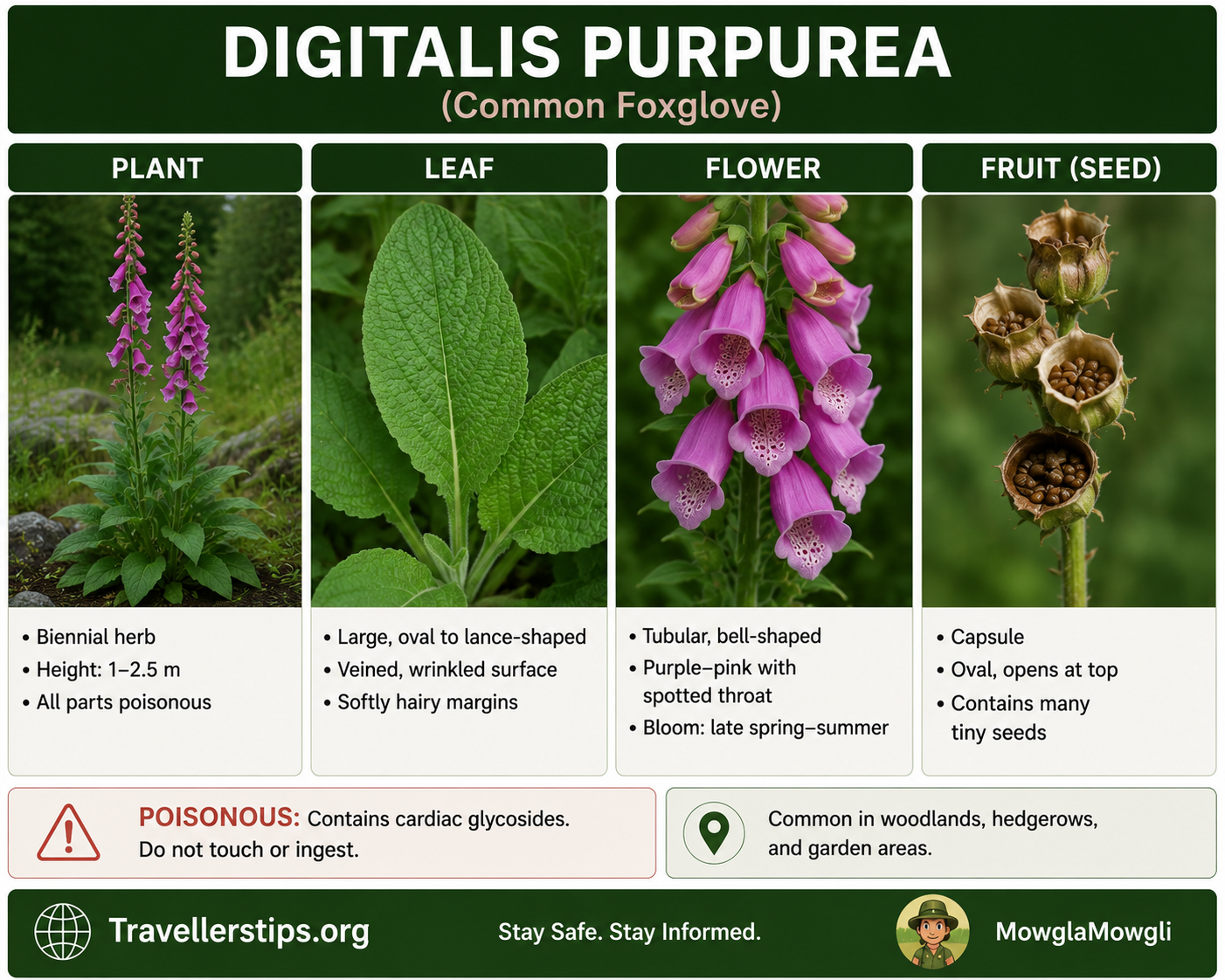
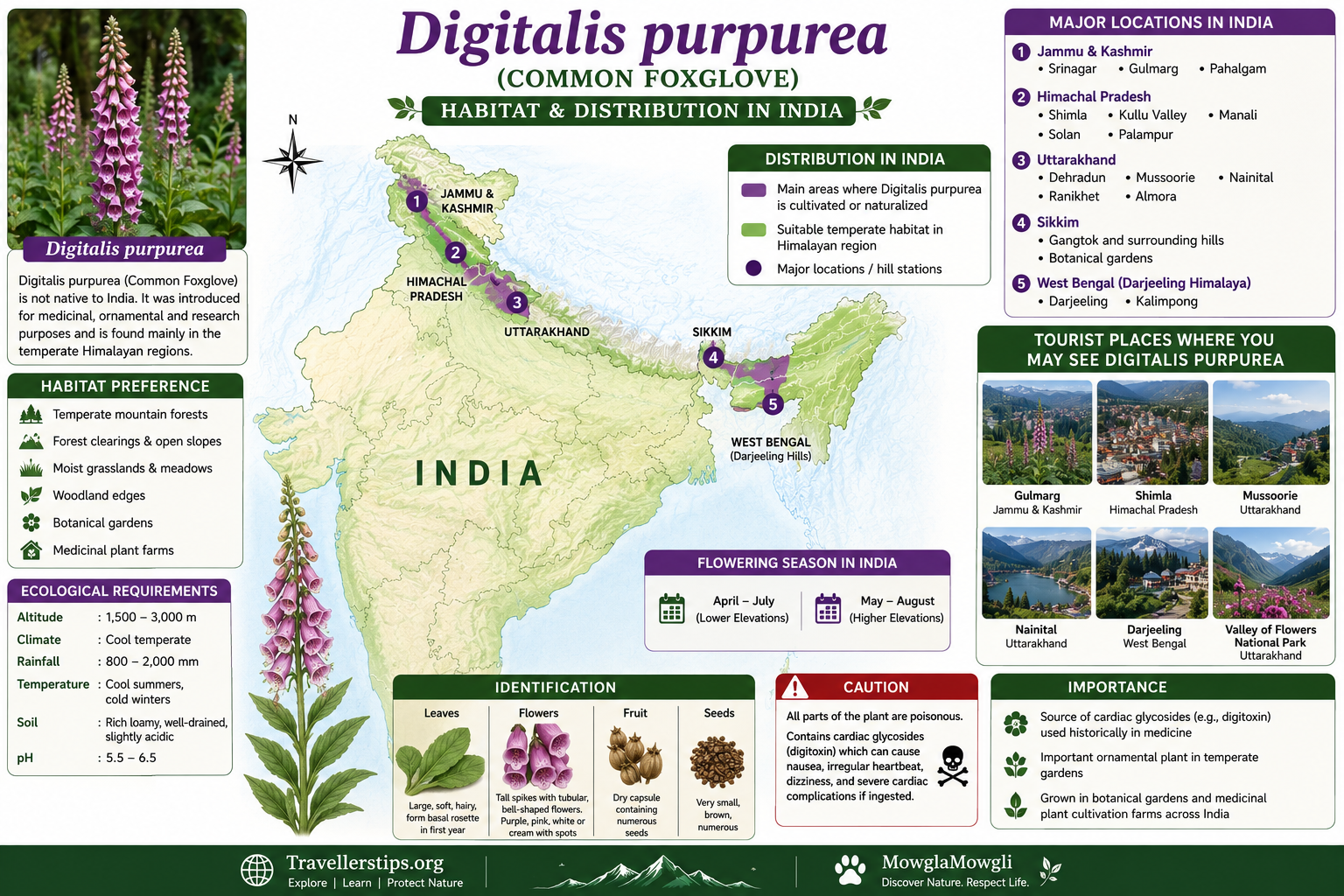
Digitalis purpurea
Common Name: Foxglove and Purple Foxglove.
—Image:12 Identification guide of Digitalis purpurea—
Found :
- Area: The ideal climate to grow this plant is a cool and temperate region. Well-drained and moist soil is suitable for growing the plant. They grow beautifully and smoothly in partial shade from the sunlight.
- Location: This species is found in the high-altitude regions, such as the Himalayan regions like Uttarakhand, Himachal Pradesh and Jammu and Kashmir. People also cultivate in the ornamental gardens around India.
Important facts :
- Digitalis purpurea is one of the most poisonous flowering plants in India and the World.
- All parts of the plant contain digoxin and digitoxin (cardiac glycosides).
- Consuming leaves, seeds and flowers of Foxglove causes an irregular Heartbeat, vomiting and other problems.
- Digoxin and Digitoxin are used to prepare medicine for the treatment of heart conditions like heart failure, Heath asthama and also kidney functions.
—Map:12 Habitat & Distribution of Digitalis purpurea in India—
………………………………………………..
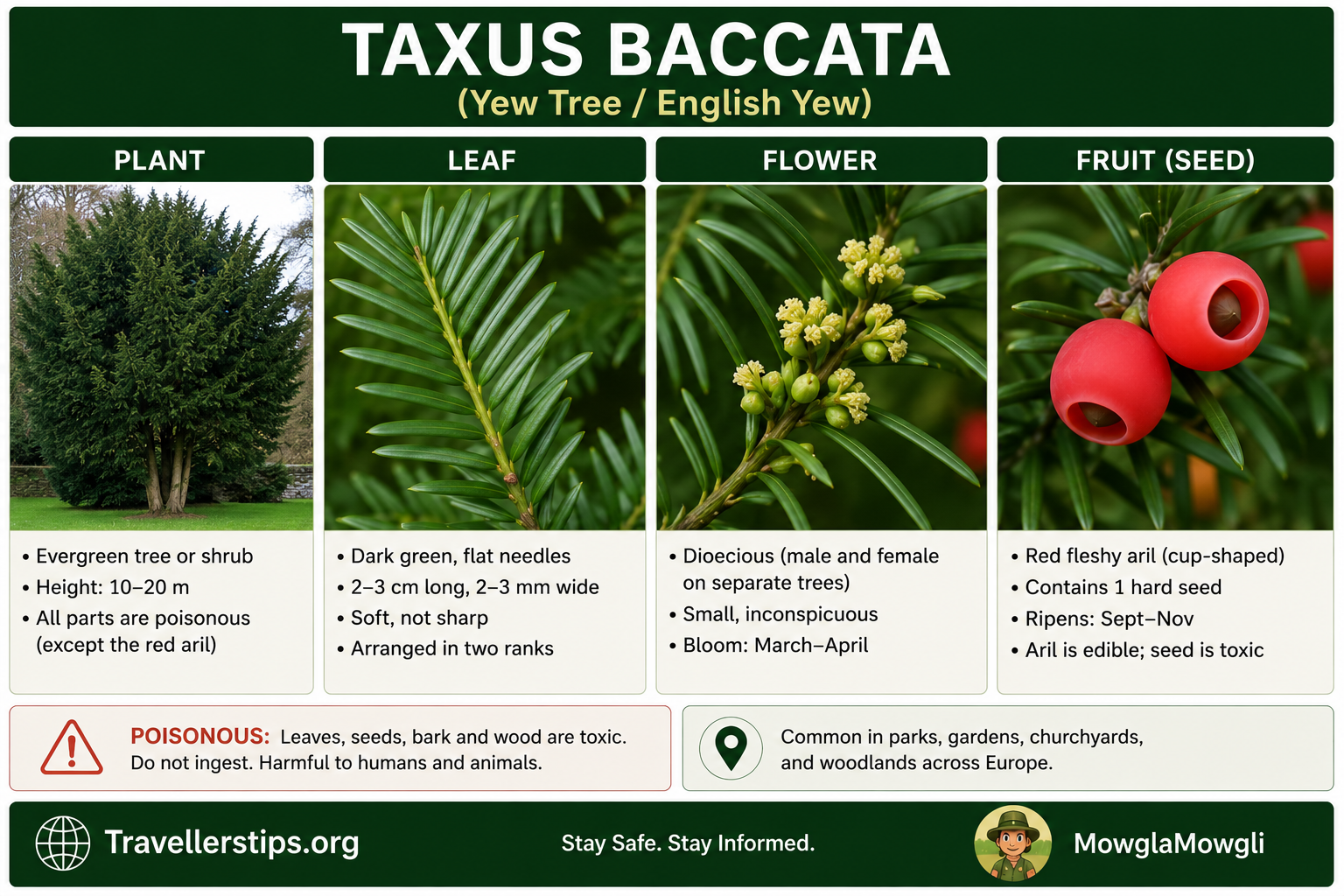
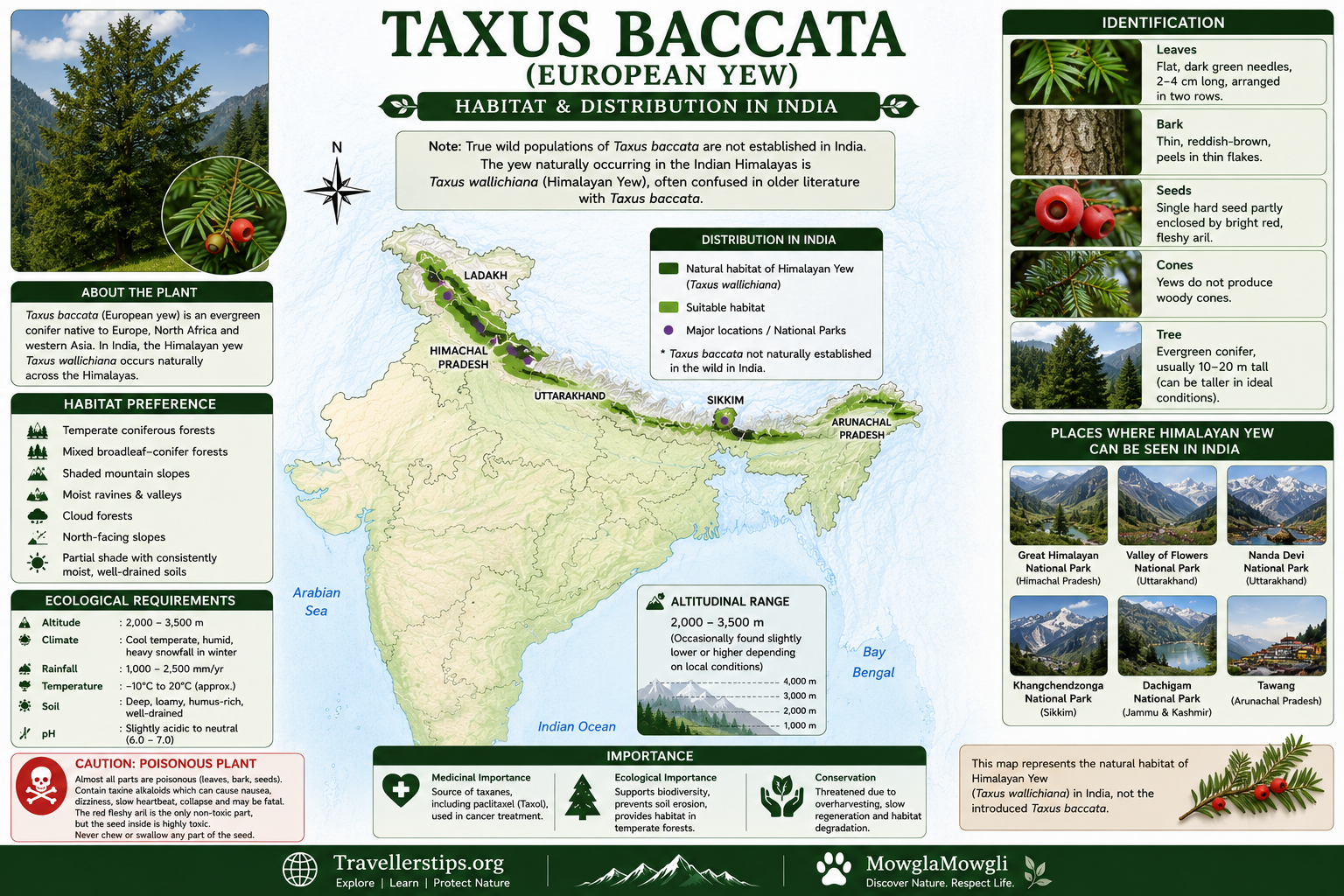
Taxus baccata
Common Name: European Yew, Himalayan Yew or Yew.
—Image:13 Identification guide of Taxus baccata—
Found :
The are grow in the cool and moist mountain forest. Mainly, they are found in the high altitude region, 2000 meters to 3500 meters, like Jammu and Kashmir, Sikkim, Uttarakhand, Himachal Pradesh and Arunachal Pradesh.
Important facts :
- Yew is another highly poisonous plant in our world.
- All parts of Yew contain highly toxic “Taxines“. It can cause a heart attack and irregular respiration.
- One of the great benefits of the Yew tree, it is used for the preparation of various types of cancer medicine, especially breast cancer.
- Birds eat the fruit of the yew without any Harmful effect.
—Map:13 Habitat & Distribution of Taxus baccata in India—
………………………………………………….
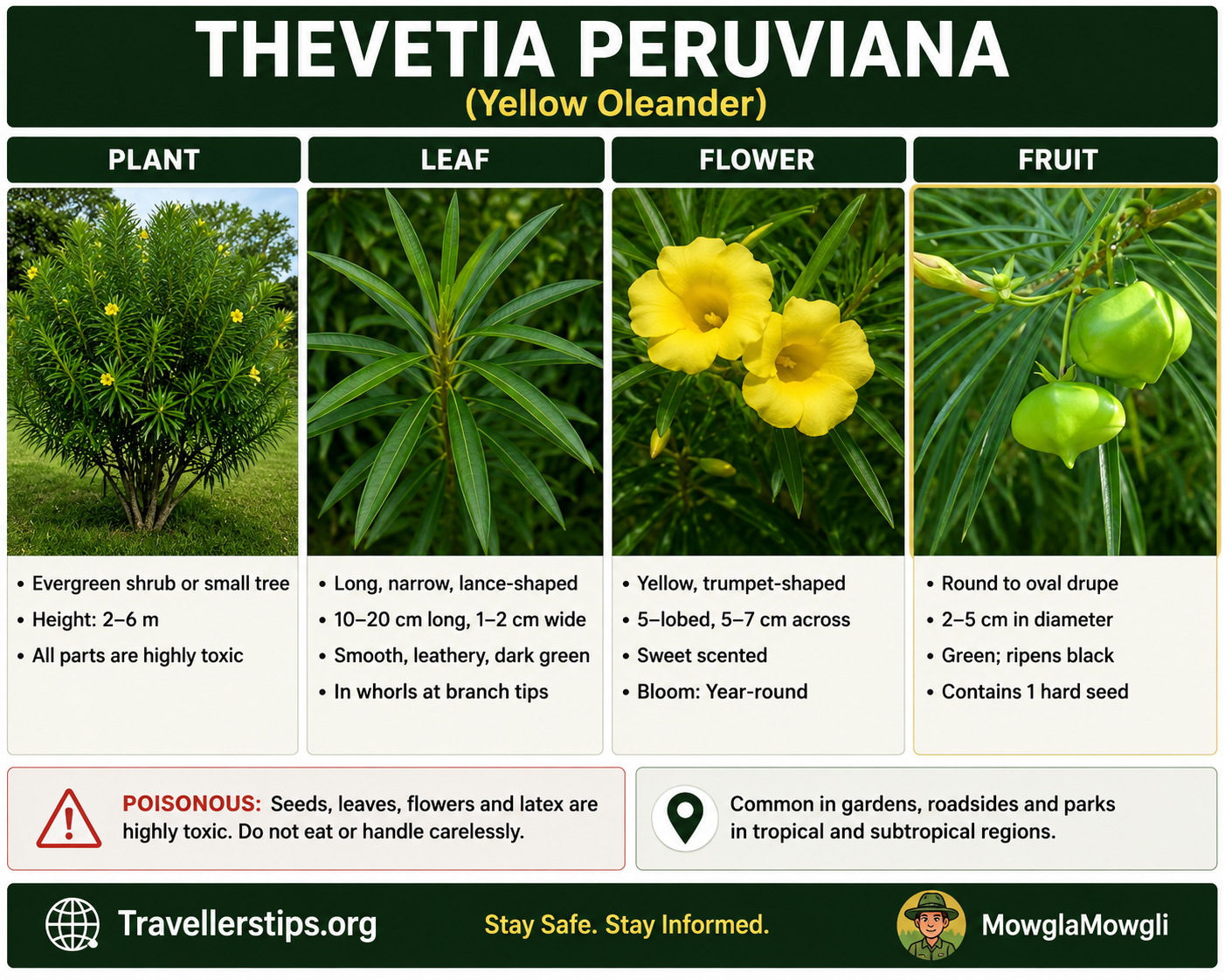
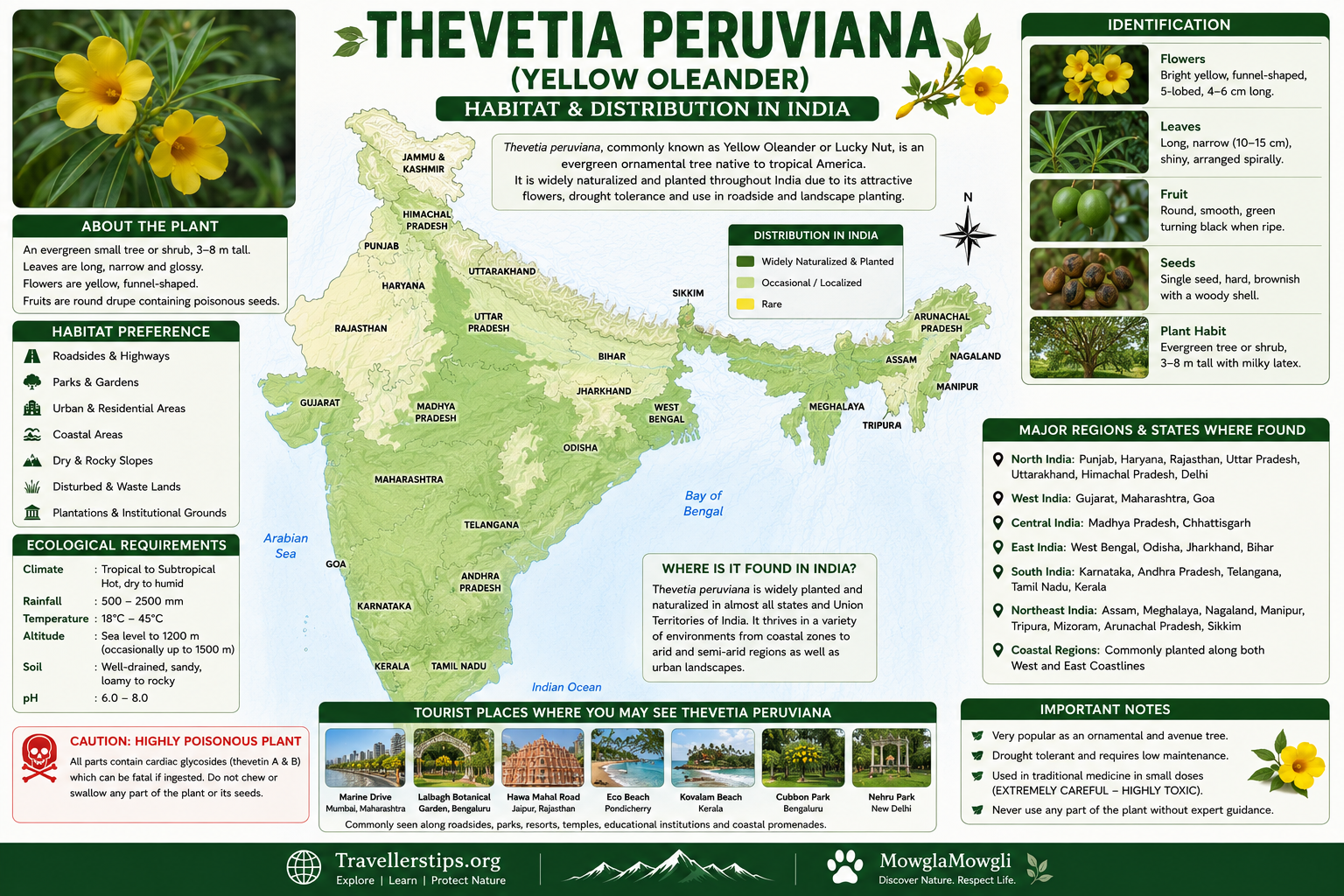
Thevetia peruviana
Common name: Yellow Oleander, Lucky Nut Tree.
—Image:14 Identification guide of Thevetia peruviana—
Found :
- Area: They grow in the Tropical and subtropical regions. Yellow Oleander grows properly in a dry and hot climate. It is looking so beautiful, that’s why people cultivate it in the garden, roadside, school campus, temple and park.
- Location: Odisha, Assam, West Bengal, Uttar Pradesh, Kerala, Maharashtra, Telangana, Andhra Pradesh, Karnataka, Kerala and Bihar.
Important Facts :
- Yellow Oleander is one of the most attractive plants in India.
- All parts of the plant contain cardio glycosides like Peruvoside, Thevatin A, Thevatin B and Neriifolin.
- The seed is more poisonous and dangerous than other plant parts.
- A small piece of seed is able to create serious issues for humans, dogs, cattle, and other mammals, while Many birds consume fruit without any issue.
—Map:14 Habitat & Distribution of Thevetia peruviana in India—
…………………………………………….
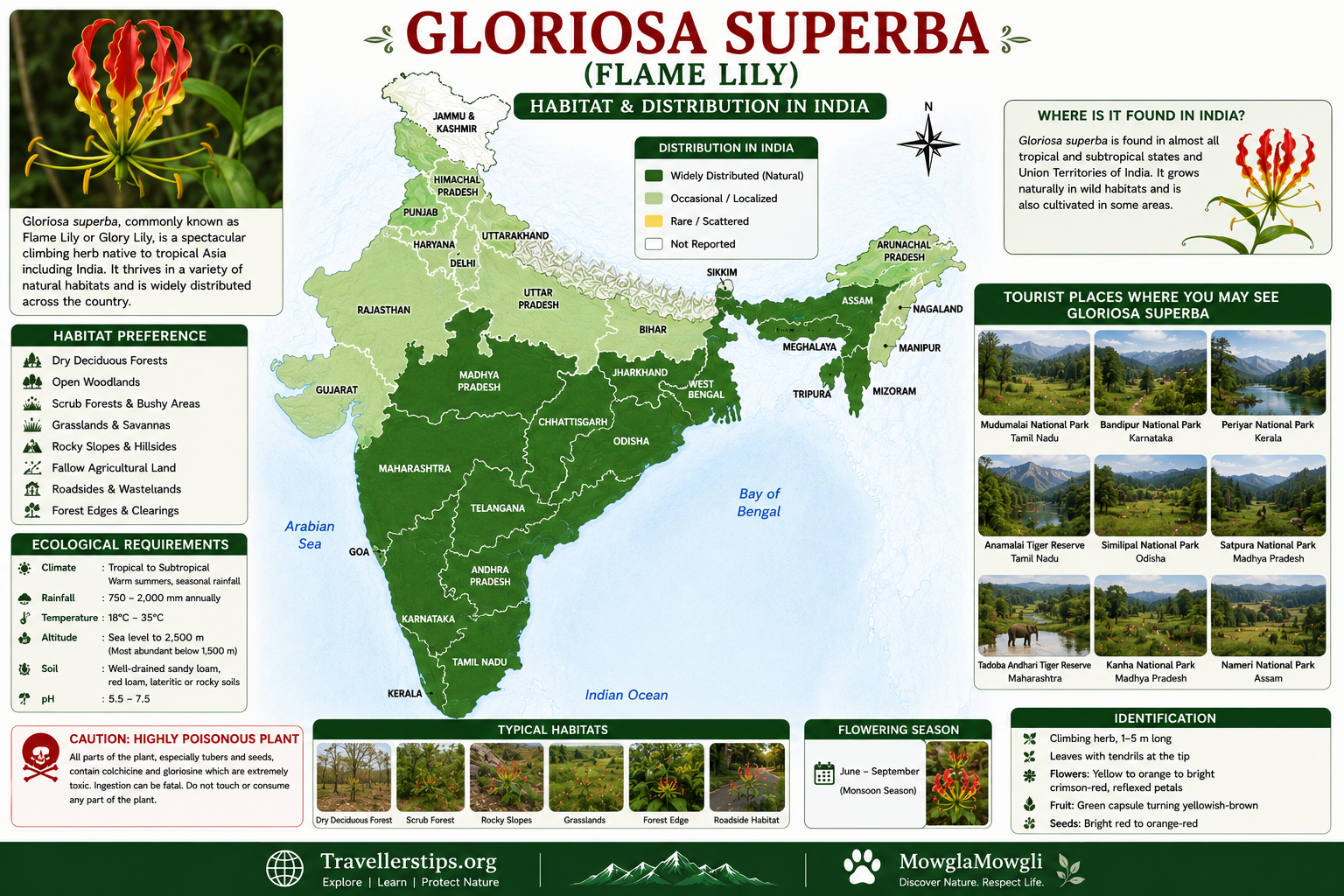
Gloriosa superba
Common name: Flame Lily, Kalihari (Hindi), Fire Lily and Glory Lily.
—Image:15 Identification guide of Gloriosa superba—
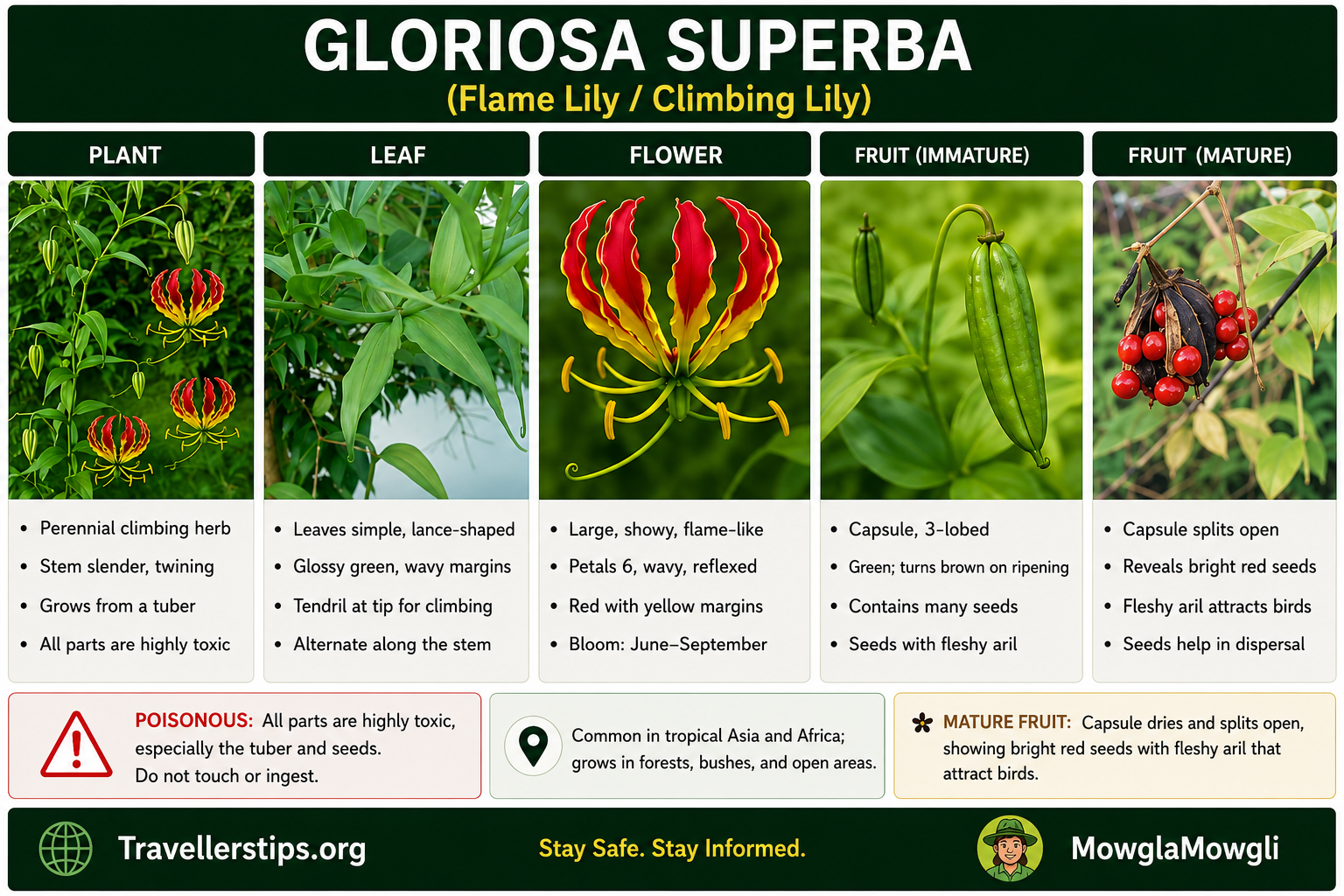
Found :
- Area: They grow in tropical and subtropical places. Flame Lily grows in the forest, Grassland, Hillslopes, margins of agricultural fields, and also in scrubland.
- Location : (Odisha, West Bengal, Assam, Bihar, Jharkhand, Chhattisgarh, Madhya Pradesh, Maharashtra, Karnataka, Kerala, Tamil Nadu, Andhra Pradesh, Telangana, Western Ghats and Eastern Ghats regions) need to create a map.
Important Facts :
- Flame Lily is another of the most poisonous plants in India.
- This Lily contains gloriosine alkaloids and Colchicine poison. Small amounts of gloriosine alkaloids and Colchicine can create a serious condition.
- Roots are the most poisonous compared to other parts of the tree. This plant is poisonous to humans and animals.
- Flame lily plays a key role in preparing medicine for gout, snakebites, rheumatism and arthritis.
—Map:15 Habitat & Distribution of Gloriosa superba in India—
………………………………………………


…………………………………………..
Our Ambition to share our knowledge and experience to make your Journey beautiful and peaceful. Our knowledge will save you from scams and other dangerous things. We believe that we are a family. If you want to know about dangerous molluscs or sea creatures like the beautiful Snail, you can click on this link and read it. We have described it beautifully with a proper map.
Thank you so much for Reading. If you have any questions, then write in the comment section. We will definitely reply.